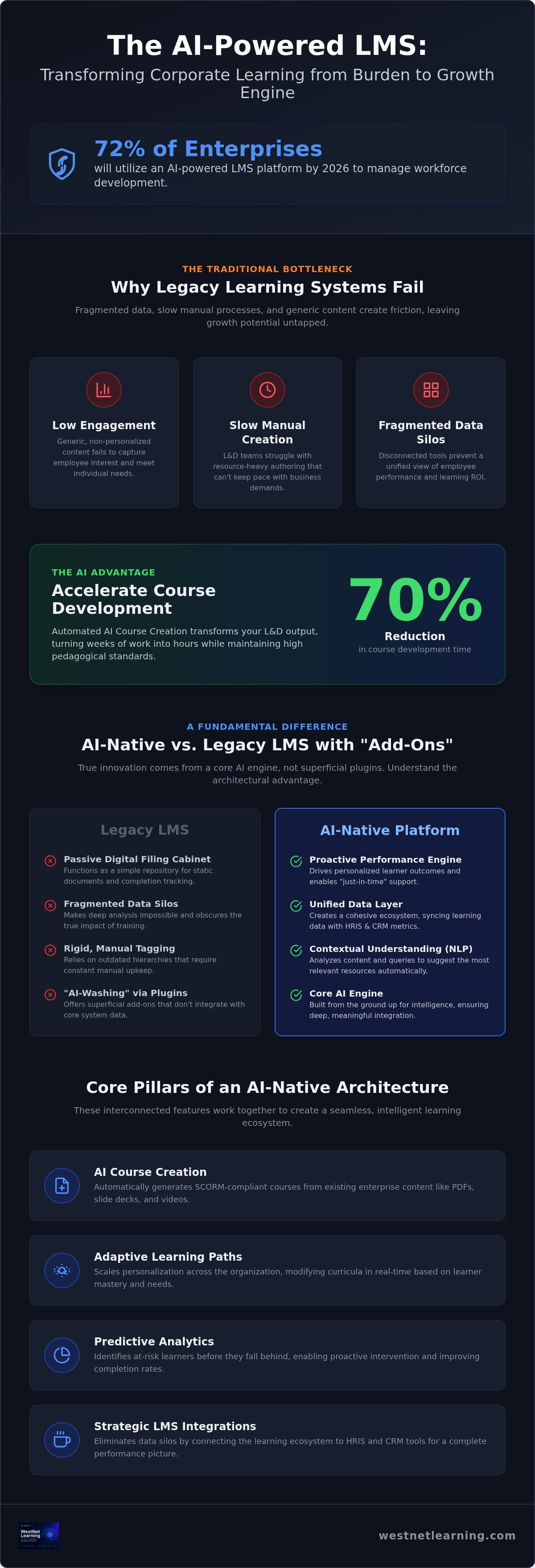
By 2026, 72% of enterprises will utilize an AI powered LMS platform to manage their workforce development. This shift isn't just a trend; it's a mandate for survival in an increasingly complex corporate landscape. You've likely felt the friction of fragmented learning data scattered across multiple disconnected tools. You've watched your L&D teams struggle with manual course creation processes that move far too slowly to meet real-time business demands. When content remains generic and non-personalized, employee engagement inevitably craters, leaving your organization's growth potential untapped and its talent underutilized.
It's time to bridge the gap between operational obstacles and systemic improvement. This guide demonstrates how forward-thinking leaders leverage an AI powered LMS platform to reduce course development time by 70% while personalizing employee growth at an unprecedented scale. We'll examine the move toward automated compliance tracking and the power of seamless integration with your existing enterprise tools. By the end of this discussion, you'll understand how to position your training infrastructure as a bold innovator and a strategic architect of long-term success.
Key Takeaways
- Accelerate your L&D output. Discover how automated AI Course Creation reduces development cycles by 70% while maintaining high pedagogical standards.
- Distinguish between true innovation and "AI-washing." Learn why a native AI powered LMS platform outperforms legacy systems that only offer superficial plugins.
- Scale personalization across your entire organization. Understand the mechanisms that allow machine learning to tailor learning paths for thousands of individual users simultaneously.
- Eliminate data silos through strategic LMS Integrations. See how connecting your learning ecosystem to HRIS and CRM tools creates a unified view of employee performance.
- Transform your training from a logistical burden into a high-speed growth engine. Identify the specific features that drive higher retention and measurable ROI for the enterprise.
The Shift to Intelligence: Defining the AI Powered LMS Platform
A traditional Learning Management System (LMS) functioned primarily as a digital filing cabinet. It was designed for record-keeping, tracking completion dates, and housing static documents. However, the modern enterprise requires more than a passive repository. An AI powered LMS platform represents a fundamental departure from this legacy model. In these systems, machine learning isn't an optional plugin or a superficial add-on. It's the core engine that drives every interaction.
This shift moves the focus from content delivery to personalized learner outcomes. Instead of pushing the same generic module to every employee, the system analyzes individual performance data to determine what each person needs to succeed. It transforms the L&D department from a cost center into a dynamic engine for performance enablement. By focusing on the learner's specific context, organizations can finally bridge the gap between theoretical knowledge and practical application.
From Passive Records to Proactive Enablement
Legacy systems often struggle to keep pace with the rapid shifts in the digital market. They rely on manual tagging and rigid hierarchies that quickly become obsolete. Natural Language Processing (NLP) changes this dynamic by allowing the platform to understand the context of learning materials and user queries. It moves the needle from "one-size-fits-all" training to "just-in-time" enablement. When a salesperson struggles with a specific product feature, the system recognizes the gap and delivers the relevant module instantly.
- Contextual Understanding: NLP identifies the nuances in training content to suggest the most relevant resources automatically.
- Adaptive Learning Paths: The system modifies the curriculum in real-time based on demonstrated learner mastery.
- Predictive Analytics: Algorithms identify at-risk learners before they fall behind, allowing for proactive intervention.
The Core Pillars of an AI-Native Architecture
True AI-native systems handle data differently than legacy databases. Traditional platforms often suffer from fragmented data silos that make deep analysis impossible. A sophisticated AI powered LMS platform utilizes a unified data layer. This architecture allows for cross-platform intelligence, syncing learning progress with real-world performance metrics from your existing enterprise tools. It creates a cohesive ecosystem where data flows freely between departments.
Deploying these systems through a cloud-based SaaS model provides a significant advantage. It ensures that your organization always has access to the latest machine learning models and security updates without manual intervention. You avoid the "AI-washing" common in older software by choosing a platform built from the ground up for intelligence. This architectural foundation is what allows for a 70% reduction in course development time and the seamless scaling of personalization for tens of thousands of users.
Accelerating Content Cycles: The Impact of AI Course Creation
Manual course authoring is the single greatest bottleneck in modern L&D. It's a slow, resource-heavy process that often results in content being outdated before it's even launched. By deploying an AI powered LMS platform, organizations can fundamentally re-engineer this cycle. Instead of weeks or months, high-quality training modules are produced in a matter of hours. This isn't just about speed; it's about strategic agility.
This efficiency offers a significant strategic advantage. A 70% reduction in course development time means your subject matter experts spend less time on formatting and more time on strategy. Automated updates further enhance this value by maintaining content accuracy. When internal policies or external regulations change, the system identifies the affected modules and suggests updates, ensuring your workforce never relies on obsolete information. This is the strategic advantage of an AI powered LMS platform.
Automating the Authoring Workflow
Transform raw enterprise data into actionable learning. AI Course Creation tools ingest existing PDFs, slide decks, and training videos to generate SCORM-compliant modules automatically. These systems don't just copy text; they analyze the material to build interactive elements and knowledge checks instantly. AI Authoring serves as the bridge between raw knowledge and structured learning.
- Rapid Ingestion: Convert existing videos and documents into structured courses in minutes.
- Interactive Generation: Build quizzes and branching scenarios without manual coding.
- Automated Compliance: Ensure all content aligns with current regulatory standards through real-time updates.
Personalization at Scale through Generative AI
Generic content leads to low engagement. Generative AI solves this by tailoring delivery based on individual employee performance data and skill gaps. If a team member excels in technical execution but struggles with compliance, the system adjusts the curriculum to focus on the area of greatest need. This level of precision acts as a stabilizing force for global teams, ensuring consistent, high-quality instruction regardless of location.
High-quality automated content guarantees that every branch of your organization receives the same caliber of training. Localization is no longer a hurdle; it's an integrated feature. Advanced models handle the nuances of regional languages and cultural contexts, allowing for a truly unified global workforce. If you want to streamline your training operations today, explore our platform features to see the technology in action.
Strategic Evaluation: AI-Native vs. Legacy LMS Add-ons
Distinguishing between deep machine learning and "AI-washing" is a critical skill for the modern L&D leader. Many legacy vendors have rushed to add superficial AI features to their aging infrastructures. These "bolted-on" solutions often fail to deliver the speed or accuracy required for enterprise-scale growth. A true AI powered LMS platform is designed from the foundation to process data intelligently, ensuring that every recommendation and automated course is grounded in architectural integrity.
Reliability is the hallmark of a native system. When AI is an afterthought, the system often suffers from latency and data inaccuracies that frustrate users. Native platforms provide a stabilizing force by maintaining a high standard of performance even under the weight of complex global operations. Choosing a native architecture ensures that your organization avoids the hidden costs of managing multiple disconnected tools, leading to a significantly lower long-term total cost of ownership (TCO).
Architectural Integrity and System Performance
Bolted-on AI features frequently lead to fragmented data silos. These silos prevent the system from creating a unified profile of employee progress, which directly impacts the accuracy of predictive analytics. Real-time processing is non-negotiable for adaptive learning paths. If the system can't analyze a learner's response instantly, the training remains static and generic. WestNet AI LMS eliminates these friction points by utilizing a cohesive data layer that supports seamless, real-time intelligence across the entire enterprise.
Future-Proofing Your Learning Ecosystem
Scalability is a primary concern for organizations managing tens of thousands of users. AI-native platforms evolve faster because they utilize continuous machine learning to refine their algorithms based on actual usage patterns. This means the system gets smarter and more efficient every day. To ensure you're investing in a future-ready solution, use this checklist during your next platform demo:
- Data Cohesion: Does the AI operate on a unified data layer or through external plugins?
- Processing Speed: Are adaptive recommendations generated in real-time or after a delay?
- Operational Scale: Can the AI powered LMS platform handle sudden spikes in user activity without performance degradation?
- Native Integration: Is the AI deeply integrated into the course creation and analytics engines?
Strategic architects of corporate learning don't settle for superficial fixes. They demand systems that can bridge the gap between current operational states and future goals. By prioritizing architectural integrity, you position your organization to harness the full power of technological innovation without the baggage of legacy limitations.
The Integration Framework: Connecting AI to the Enterprise
An AI powered LMS platform is only as effective as the data it can access. Isolated systems create operational friction, preventing a clear view of how training impacts bottom-line results. To remove these obstacles, your organization must establish a robust integration framework. Seamless LMS Integrations bridge the gap between learning and performance, ensuring that every data point contributes to a unified ecosystem of growth. APIs serve as the vital connective tissue in this architecture, syncing information between your learning platform and existing HRIS or CRM systems.
This connectivity allows for accurate employee performance tracking across every department. When your LMS speaks directly to your CRM, you can correlate sales training completion with actual revenue growth. This level of visibility transforms L&D from a siloed function into a strategic driver of corporate strategy. It ensures that your technology stack remains a cohesive unit rather than a collection of fragmented tools.
Synchronizing the HR Tech Stack
Establishing a synchronized environment requires a methodical approach to data flow. IT departments value a clear, sophisticated path through the complexities of enterprise software. Our roadmap for a 30-day implementation cycle focuses on three critical stages:
- Step 1: Mapping data fields. Align your AI models with existing employee records to ensure that personalized learning paths are based on accurate historical data.
- Step 2: Establishing secure API connections. Build reliable pipelines for real-time reporting that allow managers to see progress as it happens.
- Step 3: Configuring automated triggers. Set up systemic responses for compliance and certification, ensuring that your workforce stays current without manual oversight.
Security and Data Privacy in the AI Era
Security is the foundation of any enterprise-grade e-learning environment. Large organizations require a stabilizing force that can handle significant complexity while protecting sensitive employee information. We prioritize rigorous security standards, including SSO for streamlined access and SOC2 compliance for data integrity. These protocols ensure that your AI powered LMS platform remains a secure asset within your corporate network.
Address privacy concerns by utilizing dedicated cloud instances. This architectural choice provides the isolation necessary for large-scale operations, giving you total control over how AI models utilize your proprietary data. It ensures that your organizational intelligence remains your own while still benefiting from the speed of machine learning. Accelerate your digital transformation by scheduling a custom demo of our LMS Integrations to see this framework in action.
Driving ROI: The WestNet AI LMS Strategic Advantage
ROI in the enterprise space is defined by the speed of adaptation. An AI powered LMS platform provides the agility required to respond to market shifts instantly. By utilizing WestNet LMS, organizations eliminate the traditional bottlenecks of L&D, transforming training from a logistical cost into a competitive advantage. The 70% reduction in course development time isn't just a metric; it represents the ability to deploy mission-critical knowledge at the speed of business. This efficiency allows your L&D team to pivot from content production to strategic performance enablement.
Cohesion is the cornerstone of successful scaling. Large organizations often struggle with the complexity of managing thousands of users across multiple regions. Our architecture acts as a stabilizing force, handling significant complexity with ease while maintaining a polished, professional user experience. By centralizing your learning data within a unified, AI-native ecosystem, you remove the operational obstacles that hinder growth. You aren't just buying a tool; you're investing in a strategic partnership designed for long-term intelligence and organizational empowerment.
Maximizing Engagement with Advanced Gamification
Engagement is the foundation of long-term employee retention. Advanced gamification within an AI powered LMS platform goes beyond simple leaderboards and badges. It utilizes machine learning to adapt challenges and rewards to different personality types, ensuring that every employee feels motivated and recognized. This personalized approach drives measurable performance gains, as engaged workers are 20% more likely to apply their learning to daily operations compared to those using generic systems. We view this as empowering the workforce through sophisticated, results-oriented design.
- Dynamic Incentives: AI adjusts difficulty levels and reward structures based on individual progress and learning styles.
- Social Connectivity: Foster a culture of collaborative growth through integrated peer-to-peer challenges and knowledge sharing.
- Retention Driven: Connect learning milestones to career development paths to decrease turnover and increase internal mobility.
The Path Forward: Modernizing Your Learning Strategy
Modernizing your learning strategy requires a bold departure from fragmented legacy tools. Stop struggling with "bolted-on" features that fail to deliver on their promises. WestNet LMS stands as your strategic architect, bridging the gap between your current state and a future-ready learning ecosystem. We offer the stability and intelligence needed to scale from small teams to tens of thousands of users without friction. Our commitment to systemic improvement ensures that your organization remains at the forefront of technological innovation.
The transition to a sophisticated, AI-native environment starts with a single step. You can begin with a 30-day free trial to experience the seamlessness of our architecture firsthand. Alternatively, Request a personalized demo of WestNet LMS to see how we can tailor our solutions to your specific organizational goals. Don't let outdated methods hinder your growth potential when a clear path to modernization is available today. Take control of your enterprise growth and empower your workforce with the intelligence they deserve.
Architecting the Future of Corporate Intelligence
The transition from legacy record-keeping to a sophisticated AI powered LMS platform marks a pivotal shift in corporate strategy. By prioritizing an AI-native architecture, your organization moves beyond fragmented data toward a unified ecosystem of growth. Automated content cycles now allow L&D teams to achieve a 70% reduction in course development time, ensuring that mission-critical knowledge reaches your workforce at the speed of the market.
Reliability and security remain the bedrock of this evolution. WestNet LMS offers a stabilizing force for large-scale operations, providing enterprise-grade security and SOC2 compliance that protects your proprietary intelligence. Whether you are managing a specialized team or scaling for 10,000+ users, our platform delivers the consistency and precision required for sustainable success.
Don't let outdated methods hinder your progress. It's time to bridge the gap between operational complexity and streamlined efficiency. Start your 30-day free trial of WestNet AI LMS today and experience the power of a truly intelligent learning partner. We look forward to supporting your journey toward a more empowered and agile workforce.
Frequently Asked Questions
What is an AI-powered LMS platform and how does it differ from a traditional LMS?
An AI powered LMS platform utilizes machine learning as its core engine rather than relying on static databases. Traditional systems act as passive repositories for record-keeping and document storage. In contrast, an AI-native system proactively analyzes learner data to deliver personalized paths and predictive insights. This shift transforms the training environment from a simple administrative tool into a dynamic engine for performance enablement across the entire enterprise.
How does AI course creation software reduce development time by 70%?
AI Course Creation automates the labor-intensive tasks of manual content authoring. The software ingests existing enterprise data, such as PDFs and videos, to generate structured modules and interactive assessments instantly. By removing the need for manual formatting and quiz generation, L&D teams can bypass traditional bottlenecks. This systemic improvement allows subject matter experts to focus on strategy while the technology handles the repetitive logistical hurdles of production.
Is an AI-powered LMS secure for large enterprise organizations?
Security is a foundational element of enterprise-grade platforms. WestNet AI LMS utilizes dedicated cloud instances and adheres to rigorous standards like SOC2 compliance to ensure data integrity. Single Sign-On (SSO) integration provides streamlined access while maintaining strict control over proprietary information. These protocols offer a stabilizing force for organizations managing sensitive employee data, ensuring that technological innovation never comes at the cost of operational safety or privacy.
Can an AI LMS platform integrate with my existing HRIS like Workday or SAP?
Yes, seamless LMS Integrations are essential for accurate performance tracking. Our platform utilizes secure APIs to sync data between the learning environment and existing HRIS or CRM systems like Workday and SAP. This connectivity eliminates fragmented data silos, allowing for real-time reporting on employee progress. By bridging the gap between different operational states, you create a cohesive tech stack that supports informed decision-making and strategic growth.
How does AI improve employee engagement and training completion rates?
AI improves engagement by personalizing the learning experience to match individual employee needs and personality types. Instead of generic content, the system delivers adaptive paths that address specific skill gaps in real-time. Integrated gamification tools further motivate users through dynamic challenges and social connectivity. When training feels relevant and rewarding, completion rates rise, leading to measurable performance gains and higher long-term retention across the workforce.
What is the implementation timeline for a scalable AI-powered LMS?
Most organizations achieve a full implementation within a 30-day cycle. This roadmap includes mapping data fields, establishing secure API connections, and configuring automated compliance triggers. Our methodical approach ensures that even large-scale operations with tens of thousands of users can transition without significant downtime. This efficient pacing mirrors the productivity-focused nature of the platform, positioning your organization for a rapid shift toward future-ready training solutions.
Does WestNet offer a free trial for its AI LMS platform?
WestNet provides a 30-day free trial to allow decision-makers to evaluate our sophisticated architecture firsthand. This period offers full access to core features, including automated course management and advanced analytics. Organizations can also request custom demos to see how our AI powered LMS platform handles their specific logistical challenges. It's a strategic opportunity to witness the empowerment of your workforce through cutting-edge technology before making a long-term commitment.