The easiest course to launch may not be the right one for your workforce. Ready made workplace harassment training courses can simplify deployment, but standard content doesn’t automatically align with your policies, employee roles, or the requirements that apply where your staff work.
If you’re comparing options, look beyond course availability. Consider whether employees and supervisors receive relevant instruction, whether scenarios reflect your workplace, and whether the learning experience suits your workforce. You’ll also need a consistent way to assign training and track completion.
This guide explains how to evaluate course content, legal fit, learner experience, and delivery tools before making a selection. You’ll learn what to compare across audiences, scenarios, accessibility, and formats, how general instruction differs from organization-specific guidance, and why delivery matters alongside course quality.
WestNet Off-the-Shelf eCourses provide ready-made content, while the AI Enhanced LMS supports automated enrollment, task automation, and learning analytics and reporting. Together, they provide tools for delivering training and overseeing completion across your workforce.
Key Takeaways
- Assess ready made workplace harassment training courses against your organization’s policies, reporting routes, and applicable requirements.
- Compare employee and supervisor coverage, including instruction on recognizing and reporting concerns, retaliation, and respectful workplace expectations.
- Use a practical checklist to compare ready-made, custom, and public training across content control, learner experience, and administrative effort.
- Plan a rollout that defines audiences, reviews course content, communicates expectations, and tracks completion without treating records as proof of every legal duty.
- Pair WestNet Off-the-Shelf eCourses with the AI Enhanced LMS to support course assignment and training oversight through automation and reporting.
What ready-made workplace harassment training courses cover, and what they do not
Ready-made workplace harassment training courses are pre-developed learning programs an organization can assign without building every lesson from scratch. They offer a consistent starting point, but the label doesn’t guarantee a standard syllabus. One course may focus narrowly on sexual harassment, while another covers a broader range of workplace behaviors. Compare the learning objectives and examples, not just the course title.
Use a general overview of Workplace Harassment Overview to orient your review, then assess how a course turns concepts into practical guidance. Training can support policy awareness, but it doesn’t replace current organizational policies, reporting procedures, or legal advice.
Which workplace harassment topics should buyers look for?
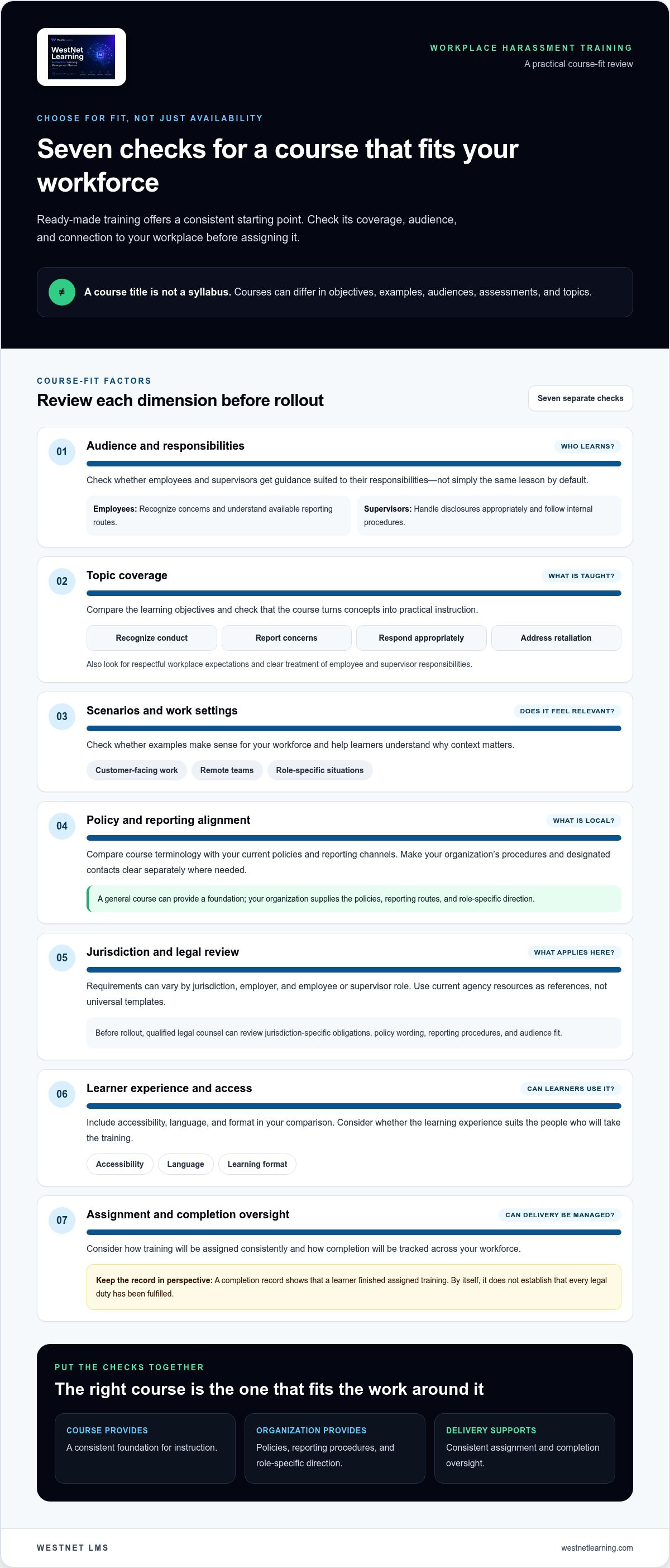
Review whether the course explains how to recognize inappropriate conduct, prevent harm, report concerns, and respond appropriately. Look for clear treatment of retaliation and respectful workplace expectations. Check whether the examples make sense for your workforce: conduct in a customer-facing setting, for instance, may raise different reporting and response questions than interactions in a remote team.
Distinguish harassment prevention from broader discrimination or civility content. These subjects can overlap, but a general respectful-workplace course may not cover the specific conduct, procedures, or responsibilities your organization needs employees to understand.
- Recognition: Does the course help learners identify relevant conduct and understand why context matters?
- Reporting: Does it explain how to raise a concern without suggesting a single route applies everywhere?
- Response: Does it clarify employee and supervisor responsibilities, including the need to take concerns seriously?
- Retaliation: Does it address the prohibition on retaliation against people who report concerns or participate in an investigation?
Don’t assume courses in a catalog include the same scenarios, audiences, assessments, or topics. Compare course outlines and sample content where available, then map coverage against your roles, work settings, and policy language.
Why course content is not the same as legal advice
Requirements can vary by jurisdiction, employer, and employee or supervisor role. Public materials from the U.S. Equal Employment Opportunity Commission and California Civil Rights Department are useful reference points, but they serve distinct purposes and shouldn’t be treated as universal templates. Use current agency resources to inform your review, not as a substitute for assessing the rules that apply to your workforce.
Before rollout, have qualified legal counsel review jurisdiction-specific obligations, policy wording, reporting procedures, and whether the course suits each audience. That review can help identify gaps a standard course may not address. A completion record shows that a learner finished assigned training; by itself, it doesn’t establish that an organization has fulfilled every legal duty.
Keep the boundary clear: ready-made content provides a foundation for consistent instruction. Your organization supplies the policies, reporting routes, and role-specific direction learners need to apply that foundation at work.
How to assess course fit for employees, supervisors, and your policies
A course can cover the right general subject and still miss the needs of your workforce. Evaluate ready made workplace harassment training courses against the people taking them, the settings where they work, and the procedures your organization expects them to follow. A fit review before assignment can show whether one learning path is sufficient or different groups need distinct content.
Match learning objectives to employee and supervisor responsibilities
Start with responsibilities, not job titles. Employees should learn to recognize concerning conduct, understand available reporting routes, and know how to respond appropriately if they experience or witness an issue. Supervisors may need additional guidance on receiving concerns, avoiding dismissive responses, and following internal procedures. Compare the stated objectives for each audience rather than assuming a shared course covers these duties equally.
- Employees: Can learners identify how to raise a concern and where to find the organization’s reporting options?
- Supervisors: Does the material explain how to handle a disclosure and follow established escalation procedures?
- Other groups: Do particular roles, such as customer-facing or remote employees, need examples that reflect their work setting?
Use the answers to decide whether one course can serve all audiences or separate employee and supervisor paths are more appropriate. A ready-made course may offer relevant scenarios, but your organization’s internal policies and designated contacts should be communicated separately.
Check policy, jurisdiction, accessibility, and language alignment
Compare course terminology with your current policy and reporting channels. If training directs learners to report concerns, explain how that instruction connects to your organization’s process. Review applicable requirements with qualified counsel before assigning a course, especially when employees work across jurisdictions or have different responsibilities.
Then assess access for the people who will take it. Review the course’s language options, caption availability, accessibility details, and usability on the devices employees rely on. Don’t infer course-language availability from an LMS interface: WestNet’s LMS supports up to 60 site languages, but that platform capability doesn’t establish which languages a particular course provides.
Turn the review into a practical fit check
Record your findings in a simple comparison before rollout. This makes gaps visible and helps decision-makers separate course suitability from platform or policy questions.
- Map each audience to its learning objectives and work settings.
- Compare examples and instructions with current policy language and reporting routes.
- Document jurisdictional questions for qualified counsel to review.
- Review the course’s language, caption, accessibility, and device details.
Once you’ve established what your workforce needs, compare those requirements with WestNet Off-the-Shelf eCourses as a ready-made content option. Keep course selection and delivery planning connected, while treating organizational policies and legal review as separate parts of implementation.
Ready-made, custom, or public training: compare the right format
Choosing a format involves balancing content control with implementation effort. Ready-made workplace harassment training courses provide structured material without requiring an organization to author every lesson. Public resources may be useful references, while custom development can address processes that standard material can’t explain in depth. Compare the options against your workforce and rollout needs, not just the amount of content provided.
| Decision factor | Ready-made course | Public resource | Custom training |
|---|---|---|---|
| Content control | Use pre-developed lessons; organizational policies may need separate explanation. | Use material within the publisher’s stated terms and scope. | Shape instruction around organization-specific processes. |
| Deployment | Can provide a structured course for assignment through a learning platform. | Access and delivery depend on how the resource is offered. | Plan development and delivery before rollout. |
| Updates | Review course content periodically against current needs. | Follow the publisher’s updates and usage terms. | Plan who maintains and revises the material. |
| Learner experience | Evaluate the available audience paths, examples, and format. | Experience varies by resource and intended audience. | Can be designed around specific learner needs. |
| Administrative workload | Reduces the effort of building every lesson internally, but still requires review and rollout. | May require separate assignment and completion processes. | Requires coordination for development, review, and delivery. |
When a ready-made course is the practical choice
Choose this route when you need organized instruction without developing each lesson from the ground up. Prioritize relevant audience coverage, examples, delivery options, and a workflow for assigning and monitoring learning. Identify what the course can’t supply, such as your reporting contacts or internal escalation steps, and communicate those details through current policies and established channels.
WestNet Off-the-Shelf eCourses provide a ready-made content route. Consider the courses alongside your delivery approach, and make course review and organization-specific guidance part of the rollout.
When public or custom training may better meet the need
Public training can be a useful reference, but its jurisdictional scope and reuse terms matter. For example, the California Civil Rights Department’s public training materials have stated limits on duplication and ingestion into third-party systems, so don’t assume public access grants permission to upload or redistribute content. Custom development is another route when internal processes require substantial organization-specific instruction.
Separate content format from delivery format, too. A self-paced course and an instructor-led session involve different scheduling and participation requirements; they aren’t interchangeable by default. Select the content model, confirm permitted use, and align delivery with the workforce and internal procedures.
Plan rollout and completion tracking for workplace harassment training
A consistent rollout turns course selection into an operational process. Define who needs training, how learners will access it, who handles questions, and what administrators need to monitor. Ready made workplace harassment training courses can provide structured instruction, but assignment and follow-through still require clear ownership.
Assign and communicate training clearly
Work through these steps in order to align course content, learner communication, and completion oversight before launch.
- Define audiences. Identify employee, supervisor, and other relevant groups, including how work locations or responsibilities affect assignment.
- Review the content. Compare course objectives with organizational policies and decide what policy-specific information must be communicated separately.
- Set assignment details. Establish enrollment timing and due dates, and assign responsibility for enrollment and learner support.
- Communicate expectations. Tell learners how to access the course, why it’s assigned, when it should be completed, and where to direct process questions.
- Monitor progress. Review activity during the rollout and follow up through the appropriate internal channel when learners haven’t completed their assignment.
Automated enrollment can help coordinate assignments where appropriate. WestNet’s AI Enhanced LMS includes enrollment automation and task automation to support a consistent administrative workflow. Set course access, assessment, certificate, and learner-record expectations according to the selected course and platform.
For a stronger rollout process, align ownership, communication, and follow-up with compliance training rollout planning. Keep learner instructions practical: provide the access route and explain where questions about internal procedures should go.
Track completion and maintain useful records
Decide in advance what administrators need to see. Depending on the selected course and platform, useful records may include assigned learners, enrollment status, completion activity, assessment results, and available certificates. Establish which fields are available and how the organization will retain relevant records.
WestNet’s AI Enhanced LMS includes learning analytics and reporting to support training oversight. These tools help administrators review activity across assigned training. For organizations managing multiple learning requirements, a centralized LMS for compliance training can bring course administration and reporting into a more coordinated workflow.
Keep the meaning of records precise. A course completion record documents course activity; it isn’t, by itself, evidence that the organization has met every legal duty. Requirements can depend on applicable rules, policies, and workforce circumstances. Maintain completion information alongside broader compliance documentation, and have qualified counsel review legal obligations. Clear tracking supports oversight, but it doesn’t replace that review.
Deliver ready-made courses through WestNet eCourses and the AI Enhanced LMS
Choosing training content and deciding how to administer it are related but separate decisions. First assess whether a ready-made course fits your audience and organizational requirements. Then determine how you’ll assign it, communicate expectations, and oversee learning activity. This distinction keeps course suitability, internal policy guidance, and platform capabilities clear throughout the rollout.
Connect ready-made content with LMS administration
WestNet Off-the-Shelf eCourses provide structured learning without requiring your organization to develop every lesson internally. Explore ready-made eCourses as one part of your evaluation, then consider how the selected content will fit your assignment and reporting workflow. Assess course audiences, accessibility, language options, and learning activities from the course information itself.
The AI Enhanced LMS supports administration with automated enrollment and task automation. Learning Analytics and Reporting help administrators review training activity and support oversight. Multiple authentication options, including single sign-on (SSO), support access management within an organization’s learning environment. These capabilities help coordinate delivery, but they don’t determine whether course content fits a particular legal obligation or internal policy.
The LMS supports up to 60 site languages. This describes the platform’s site-language capability, not the languages available in every course. For a multilingual workforce, evaluate course language separately and make sure learners can access the content and understand any organization-specific instructions that accompany it.
Move from evaluation to a confident next step
Before selecting and assigning a course, bring the key decisions together. Confirm that the content suits the intended audience, review jurisdiction-specific questions with qualified counsel, and assess how course examples relate to your organization’s work. Check usage permissions, review relevant accessibility and language details, and decide how assignments and completion activity will be tracked.
These criteria apply across training catalogs. For related guidance on comparing pre-developed learning content, WestNet’s off-the-shelf business soft skills course buyer’s guide offers a catalog-selection perspective. Evaluate content and delivery separately, then confirm that they work together for your learners.
Ready made workplace harassment training courses can streamline course development, but a reliable rollout still depends on deliberate review and administration. WestNet’s AI Enhanced LMS supports corporate training workflows with automated enrollment, task automation, and learning analytics and reporting.
Make your next training decision a stronger one
Choose ready made workplace harassment training courses as part of an ongoing learning strategy, not a one-time procurement task. Establish who owns the course review, how policy changes will be communicated, and when the organization will reassess whether the learning still reflects its workforce. Gather learner and administrator input, identify gaps, and use those findings to guide future assignments.
Keep the boundaries clear as you move forward. Course content supports employee learning, while organizational policies and qualified legal review address requirements specific to your workplace. A deliberate process connects those pieces without expecting one course to do every job.
WestNet Learning brings ready-made content and learning technology together to support corporate training workflows. Explore WestNet Learning’s training solutions, and start a free 30-day trial or request a demo to evaluate the AI Enhanced LMS for your organization.
Frequently Asked Questions
Are ready-made workplace harassment training courses enough to meet legal requirements?
No. Ready made workplace harassment training courses can support an employer’s program, but they can’t guarantee compliance across every jurisdiction or workforce. For example, an organization that hires in a new state or changes employee responsibilities may need to reassess its training plan. Have qualified counsel review applicable requirements, then document how the selected course fits alongside current policies and procedures.
What should workplace harassment training cover?
Look for instruction that helps employees recognize relevant conduct, raise concerns, and understand appropriate next steps. Consider whether examples reflect how people interact in your workplace, including through work-related digital channels or with customers and vendors. A course label alone doesn’t establish its scope. Review its stated objectives and compare them with situations employees may encounter and the guidance your organization expects them to follow.
Should employees and supervisors take different harassment training courses?
Often, separate learning objectives make sense because supervisors have responsibilities beyond understanding expected conduct. For instance, a supervisor may need to know how to receive a disclosure, preserve relevant information, and route the concern according to internal procedures, while employees need to know how to raise an issue. Map these tasks by role before assigning courses, and make escalation expectations clear outside the course as needed.
Can ready-made harassment training be added to an LMS?
Often, but technical compatibility and permission to use the content are separate questions. A course may have a particular file format or delivery method, while its license may limit copying, uploading, or redistribution. Review both before planning LMS delivery. The California Civil Rights Department, for example, states that its training materials may not be ingested into third-party systems. Don’t assume publicly accessible content can be imported.
How do organizations track workplace harassment training completion?
Set a recordkeeping process that captures who was assigned training, the relevant assignment period, and whether completion was recorded. If the course includes an assessment or certificate, decide whether those details are necessary for your internal records. The information available depends on the course and platform. Keep records organized with related training documentation, and distinguish evidence of course activity from evidence of broader compliance.
Is free government harassment training suitable for every employer?
No single public resource fits every employer by default. A government course may address a particular jurisdiction or audience, and its use terms may restrict how organizations share or deliver it. For example, the California Civil Rights Department states that its training materials can’t be ingested into third-party systems. Review the resource’s intended scope and permissions before using it in a wider workforce program.
How often should workplace harassment training be refreshed?
There isn’t one refresh schedule that applies to every organization. Set periodic review points and revisit the course when policies, reporting channels, job responsibilities, or applicable requirements change. For example, if a reporting contact or escalation process changes, update internal communications promptly rather than waiting for the next course cycle. Assign an owner to review course currency with qualified counsel, and don’t rely on publication date alone.