The biggest leadership curriculum isn’t the one with the most modules. It’s the one that targets the behaviors your leaders need to strengthen. With so many pre built corporate leadership training modules available, choosing a focused mix can feel harder than building the program itself.
Ready-made content can speed up development, but a broad catalog won’t automatically reflect your organization’s priorities. Leaders at different levels also need different skills, while distributed teams need consistent access and straightforward administration.
This guide will help you identify high-priority module topics by role, balance ready-made learning with organizational relevance, and choose a practical mix for your leadership curriculum. You’ll also see how an LMS can support assignments, automated enrollment, learner recommendations, and progress reporting, giving administrators a clearer view of participation and completion.
Start with the behavior gap, not the catalog. Then build a learning pathway that connects relevant content to the people who need it, and use the right systems to deliver and track that learning across your organization.
Key Takeaways
- Choose pre built corporate leadership training modules by the observable behavior leaders need to strengthen, not by catalog size.
- Distinguish a focused standalone module from a broader curriculum so each learning element has a clear role.
- Compare ready-made and tailored learning across speed, relevance, consistency, and administration, then combine approaches where they complement each other.
- Use a five-step selection process to connect organizational needs, learner groups, module topics, delivery plans, and evidence of progress.
- See how an LMS can help coordinate leadership learning with recommendations, automated enrollment, analytics, gamification, and administrator support.
Pre-Built Leadership Training: What Buyers Need to Know
A pre-built leadership training module is ready-made learning focused on a specific skill or challenge, such as giving useful feedback or delegating work clearly. It gives organizations a defined foundation to assign without developing every learning element from the ground up. That focus is valuable, but a module still needs to match the learners’ roles and the behavior you want to strengthen.
Separate the format from the scope. A standalone module addresses one learning need; a curriculum connects several modules into a sequence, while a multi-part development program may combine learning with ongoing practice and reinforcement. The right choice depends on the behavior you want to change and how much learning support that change requires.
What counts as a corporate leadership training module?
A module typically brings together learning objectives, instructional content, opportunities to practice, and knowledge checks. The format might be digital, virtual, or another delivery approach, and its length varies by provider and design. A module can also serve as one step in a role-based pathway, with learning selected to match a leader’s responsibilities and development priorities.
For a broader overview of the field, Leadership Development describes approaches to developing both individual and collective leadership, including experiential learning. That distinction matters: a module can introduce a skill, while applying it at work may depend on practice with real decisions and colleagues.
When do ready-made leadership modules make sense?
Ready-made learning is especially useful when managers share a repeatable development need. For example, an organization promoting new supervisors may want a consistent foundation in setting expectations, delegating tasks, and holding one-to-one conversations. Standardized content aligns core concepts across a cohort, while leaders can still apply those concepts to their own teams.
Use organizational scenarios to make that foundation recognizable. A general feedback lesson can be paired with examples based on the company’s workflows, terminology, or common team situations. The learning objective stays consistent; the context helps learners connect the behavior to daily work.
The trade-off is straightforward. Pre-built modules can support a faster, more consistent rollout, but may not address every organizational nuance. Tailored context can improve relevance, yet adding too many exceptions can fragment the learning and make administration harder. Aim for a stable core with carefully chosen examples rather than rebuilding each module around every team’s preferences.
Start with observable leadership behavior, not a long list of topics. Translate a concern into something a learner can demonstrate, such as:
- Clarify ownership and deadlines when delegating.
- Give specific, actionable feedback after a project milestone.
- Invite input from colleagues outside the immediate team before making a cross-functional decision.
These behaviors make it easier to assess whether a module is relevant and where it belongs in a learning pathway. A focused selection gives leaders a clear practice target and gives administrators a stronger basis for organizing learning around role needs.
A Practical Roundup of Pre-Built Leadership Training Module Topics
Build a shortlist around leadership behaviors, not fashionable labels. The categories below are topic areas to guide selection, not claims about titles in any provider’s course catalog. Start with foundational people-management skills, then add team or strategic topics when workplace challenges point to a clear need. This sequence keeps pre built corporate leadership training modules focused on what leaders must do differently.
Foundational modules for communication, feedback, and coaching
New managers often need practical habits for everyday conversations. Look for learning on active listening, clear communication, constructive feedback, coaching, accountability, and one-to-one meetings. A manager who avoids performance conversations, for example, may benefit from practicing how to frame specific observations and agree on a next step. These topics create a useful foundation for consistent people management across teams.
Modules for trust, psychological safety, and team effectiveness
Consider these topics when employees hesitate to raise concerns, meetings draw input from only a few voices, or disagreement becomes personal. Learning can focus on inviting different perspectives, setting expectations for respectful discussion, and handling conflict constructively. These modules can support leaders as they shape team interactions, but course completion alone can’t guarantee a particular culture or performance outcome.
Modules for change, decision-making, and leading through uncertainty
Choose change communication, critical thinking, prioritization, and decision-making topics when teams face shifting priorities or new ways of working. Tie the learning to a real situation, such as explaining why a process is changing or deciding which work to pause when capacity is limited. A concrete leadership challenge makes it easier to judge whether a topic is relevant.
Connect each category to an audience, workplace application, and observable evidence. Evidence should reflect practice or demonstrated understanding, not completion alone.
| Topic | Audience | Use case | Suggested evidence of learning |
|---|---|---|---|
| Communication and active listening | New managers | Clarify expectations in team conversations | Practice response that reflects the speaker’s concern |
| Feedback and coaching | Managers building people-management habits | Address a performance gap constructively | Feedback scenario with a specific next step |
| Trust and psychological safety | Team leads and cross-functional leaders | Encourage input and surface concerns | Plan for inviting and acknowledging dissenting views |
| Constructive conflict and team effectiveness | Leaders of collaborative teams | Keep disagreement focused on the work | Scenario response that separates issue from person |
| Change and decision-making | Leaders managing shifting priorities | Communicate a change or make a trade-off | Decision rationale or change-message exercise |
Prioritize topics with a visible connection to work. If a capability is common across a manager cohort, a shared learning foundation can create consistency; examples from real team situations can make application more relevant. WestNet’s corporate training LMS can help assign and coordinate selected content across employee groups.
Pre-Built vs. Custom Leadership Training: Which Approach Fits?
Ready-made and tailored learning solve different parts of the same problem. Pre-built content can establish a common foundation, while contextual examples connect that foundation to your organization’s leadership expectations and daily decisions. They don’t have to be competing choices.
The concern that standard content is automatically generic misses the key decision: how well does a module match a defined skill gap? A focused selection tied to an observable behavior can be more relevant than a highly customized program built around a vague goal. Use these criteria to compare the approaches:
| Decision factor | Pre-built learning | Tailored learning |
|---|---|---|
| Speed to launch | Can provide a ready-to-assign learning foundation, depending on selection and setup. | Requires development or adaptation before delivery. |
| Contextual relevance | Addresses broadly shared skills; examples may need a local connection. | Can reflect specific leadership expectations, policies, and workplace scenarios. |
| Consistency | Supports a shared baseline across teams or cohorts. | Can align closely with organizational language and practices. |
| Internal administration | Offers a defined learning unit to assign and manage; fit still needs review. | May require more coordination to define, maintain, and deliver the learning. |
When pre-built content is the stronger starting point
Start with ready-made modules when leaders share a common skill gap, need repeatable foundations, or require consistent access across teams. A standard module can give an L&D team a coherent baseline for topics such as feedback or delegation. It doesn’t guarantee behavior change or a universal time saving; it gives the organization a defined starting point to assign, reinforce, and evaluate.
When tailored or blended learning adds value
Tailored context is useful when internal expectations, policies, or recurring scenarios shape how a skill should be applied. Keep shared modules for core concepts, then add facilitated discussion or workplace application to explore how the principles fit local situations. For a closer look at approaches to contextualizing learning, explore these custom training options.
For example, a shared lesson on decision-making can establish principles for weighing evidence and communicating rationale. A team discussion can then apply those principles to an actual handoff, approval process, or shifting priority. The module remains consistent; the application becomes specific.
Use a blended approach when the capability is common but the work context varies. Select pre built corporate leadership training modules against clear needs, then identify where local examples, discussion, or practice will close the relevance gap. Keep those additions purposeful so they strengthen, rather than fragment, the shared learning foundation.
How to Select and Roll Out Leadership Modules That Fit
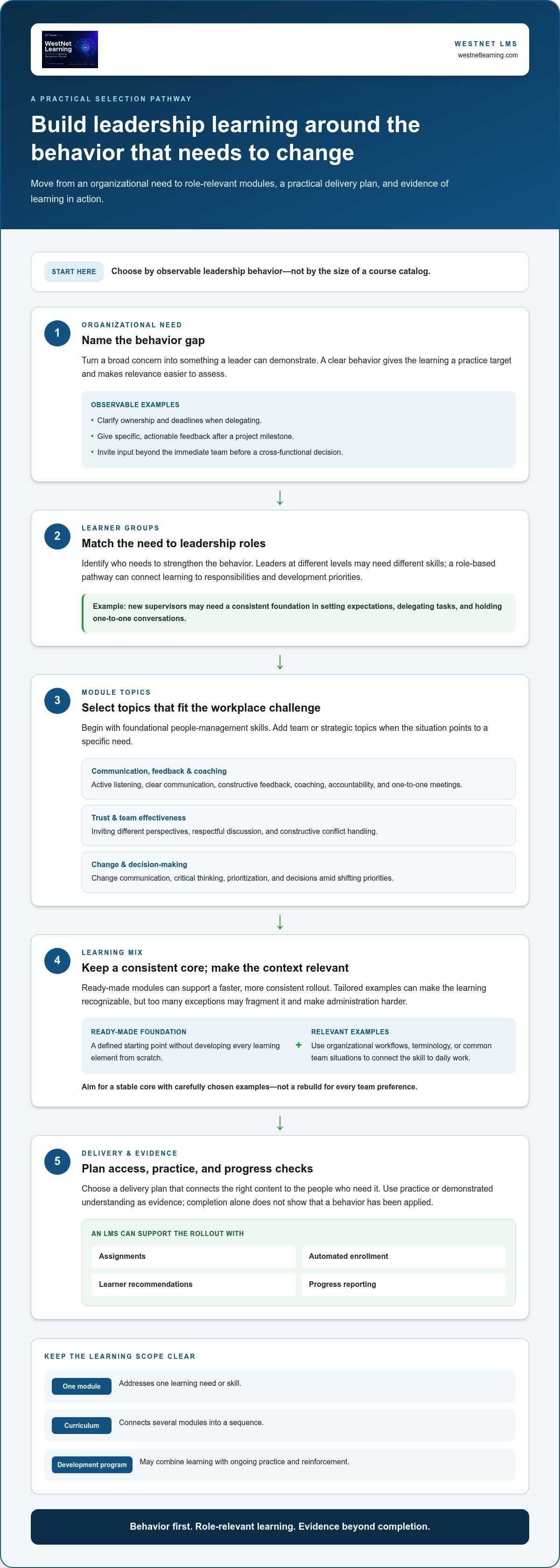
A strong rollout connects a real leadership need to the right learners, learning content, and follow-through. Use this five-step process to move from a broad development goal to a manageable plan for pre built corporate leadership training modules.
- Identify needs. Combine business priorities with manager input and learner feedback. Define the challenge in work terms, such as delayed decisions or inconsistent feedback.
- Define the audience. Separate emerging leaders, new managers, experienced managers, and senior leaders. Their responsibilities differ, so a shared topic may require different learning objectives or examples for each group.
- Shortlist topics. Map each challenge to an observable behavior and a module that teaches it. For example, “improve delegation” could become “agree on ownership, decision boundaries, and deadlines.”
- Plan delivery. Set the sequence, enrollment expectations, completion milestones, and communication responsibilities. Decide where practice, reflection, or manager conversations can reinforce learning.
- Review evidence. Track participation and assessment results, then look for opportunities to observe the target behavior at work. Completion shows activity, not behavior change on its own.
A practical employee training plan can help organize learner groups, priorities, and delivery responsibilities before launch.
Map leadership needs to roles and observable behaviors
Make the audience specific. Emerging leaders may need to practice influencing without formal authority, while new managers may be learning to set expectations. Experienced managers may focus on coaching performance, and senior leaders may need to communicate decisions across functions. Translate broad goals such as “stronger leadership” into actions learners can rehearse and managers can recognize.
Use evidence from several angles. Business priorities reveal which capabilities matter now; manager input surfaces recurring team challenges; learner feedback highlights where support is needed. Together, these perspectives help prevent a shortlist driven only by popular topic labels.
Plan the rollout, application, and measurement
Before assigning modules, determine who enrolls learners, how reminders and questions will be handled, and what completion looks like. Sequence learning so foundational topics precede more specialized development where appropriate. Pair a module with a relevant work task, a reflection prompt, or a manager conversation to encourage application.
Use learning data to monitor enrollment, completion, and assessment results. Then distinguish those indicators from workplace evidence, such as a manager observing clearer delegation in a project discussion. An LMS with automated enrollment and learning analytics can help administrators coordinate assignments and review progress without treating a dashboard metric as proof of changed behavior.
Check the content and platform fit before launch
Review whether objectives match the behavior gap, the format works for learners, and assessments check understanding rather than recall alone. Consider accessibility across devices and schedules, along with administrator effort. Map required authentication, HRIS or other integrations, and reporting workflows to the platform’s capabilities before rollout. A corporate training LMS demo guide can help structure that evaluation.
WestNet’s corporate training LMS provides tools to assign and manage learning across an organization.
Deliver Leadership Learning Through WestNet’s AI Enhanced LMS
Selecting relevant learning content is only part of the rollout. An LMS provides the operational layer for assigning modules, organizing access, supporting learners, and reviewing activity. WestNet’s AI Enhanced LMS brings these learning operations together with course delivery and reporting.
Organizations can bring selected off-the-shelf eCourses into a wider learning plan and use the LMS to coordinate access and progress. The platform also supports virtual and instructor-led modules, giving administrators options for delivering learning through different formats.
Manage assignments and learner access in one system
Automated enrollment can help administrators coordinate assignments, while user-management capabilities support administration as teams change. Single Sign-On and HRIS integration can connect access and employee information with learning administration when those features fit existing workflows.
Plan for user changes, too. Deactivated user licenses can be reused for new users, helping administrators manage access as people join or leave the learning population. Before rollout, map the enrollment process, access requirements, and reporting responsibilities so each learner group has a clear path into its assigned learning.
Support learners and review learning activity
AI-Generated Course Recommendations for learners can direct them toward relevant learning, while AI-Powered Help offers support for learners and administrators. Together, these capabilities can make it easier to find learning and address questions within the system, without replacing the need for clear program guidance.
Learning Analytics and Reporting provide visibility into learning activity and progress. Administrators can review indicators such as enrollment and completion to understand how a rollout is proceeding. Gamification features, including leaderboards and badges, can also be used as part of the learning experience. They are tools for structuring recognition, not a guarantee of engagement or behavior change.
Connect course creation and delivery to the wider learning plan
For organizations creating learning content, WestNet supports AI-Powered e-learning Creation, including SCORM or xAPI course creation. This connects new digital content with the same learning environment used to assign and track courses. Explore how AI course creation software can fit into a broader content workflow.
WestNet’s AI Enhanced LMS brings together learning access, delivery, learner support, and reporting alongside selected content. Administrators can request a demo and use the free 30-day trial to explore the platform. Explore WestNet’s LMS to see how it can support your learning operations.
Turn Leadership Priorities Into a Learning Pathway
Your next step is to test one focused leadership pathway against a real organizational need. Choose a learner group, assign relevant pre built corporate leadership training modules, and decide what evidence will show whether learning is being applied. A small, well-defined rollout gives your team a practical basis for refining the experience before extending it more broadly.
WestNet’s AI Enhanced LMS brings learning operations together, from AI-Powered e-learning Creation and automated enrollment to Learning Analytics and Reporting. A Dedicated Client Success Manager can support your platform experience as you shape the rollout.
Explore WestNet’s AI Enhanced LMS and start your 30-day free trial. Build a focused starting point, learn from the rollout, and give your leaders a clear opportunity to grow.
Frequently Asked Questions
Are pre-built leadership training modules suitable for first-time managers?
Yes. Pre built corporate leadership training modules can give first-time managers a structured way to build skills they may not have needed as individual contributors. Choose content that reflects their immediate responsibilities, such as setting expectations, holding one-to-one meetings, and handling early performance concerns. Pair learning with a chance to discuss a current team situation with their manager, so new supervisors can connect course concepts to decisions they’re making now.
Can pre-built leadership modules be combined with instructor-led learning?
Yes. A blended approach can pair self-directed modules with virtual or instructor-led learning activities. For example, managers might complete an online lesson before a facilitated discussion where they work through a leadership scenario. WestNet’s AI Enhanced LMS supports virtual and instructor-led modules, giving organizations a platform to coordinate these learning formats. Plan how each component connects so live sessions extend the learning rather than simply repeat course content.
How do you measure whether leadership training is working?
Use more than course completion to evaluate progress. Combine participation and assessment information with follow-up evidence tied to the capability being developed. If the goal is clearer delegation, a manager might review a recent project handoff with the learner and note whether ownership and decision boundaries were communicated. Look for patterns over time, and treat observations as evidence to discuss, not as proof that one course caused a business result.
Is a pre-built leadership course the same as a leadership development program?
No. A course or module is a learning component, while a development program usually coordinates multiple experiences around broader growth goals. A program could combine several courses with reflection, manager check-ins, and work assignments. Think of the module as one building block: it can address a specific capability, while the larger program determines how that capability connects to other skills and ongoing development.
Can leadership modules be assigned to different employee groups?
Yes. Organizations can assign different learning according to role, department, management level, or development priority. For instance, new supervisors might receive learning focused on team conversations, while experienced managers are assigned content related to coaching. Clear group definitions help avoid irrelevant assignments and make participation reports easier to interpret. In WestNet’s AI Enhanced LMS, user-management capabilities support organizing learners through department, organization, and hierarchy structures.
What should a buyer review in a leadership training module before purchasing?
Check that the learning objectives address a specific capability and that examples reflect situations learners are likely to encounter. Review the practice activities and assessments to see whether they ask learners to apply ideas, not just recall terminology. Also consider format, accessibility, and how the content will fit into existing learning workflows. A module on conflict, for example, should give learners a way to think through a realistic disagreement, not only describe conflict styles.
Can an LMS report on leadership course participation?
Yes. An LMS with learning analytics and reporting can provide visibility into course participation and learner progress, such as enrollment and completion activity. Administrators can use those reports to identify groups that haven’t started or learners who may need a reminder. Reporting describes activity in the system; it doesn’t independently show how someone leads at work. Pair platform data with appropriate workplace feedback to build a fuller picture.