By 2026, AI has slashed eLearning production time by up to 45 percent, yet many organizations remain tethered to sluggish legacy platforms that feel more like digital filing cabinets than growth engines. You've likely felt the friction of fragmented data scattered across disconnected tools while attempting the task of modernizing corporate learning systems in a volatile market. It's clear that the traditional, one-size-fits-all training model can no longer support a modern, agile workforce. Stop managing tools. Start architecting intelligence.
This article provides the strategic roadmap to move your organization from context chaos to a state of unified intelligence. You'll discover how to replace outdated interfaces with an AI-native ecosystem that automates content production and delivers real-time ROI tracking through advanced analytics. We'll explore the architecture required to unify your learning infrastructure and empower your employees with personalized development paths. We'll guide you through the transition from fragmented legacy training to a sophisticated, future-ready solution that drives measurable organizational growth.
Key Takeaways
- Identify the hidden costs of "context chaos" and learn how to replace fragmented legacy tools with a unified, AI-native architecture.
- Execute a strategic roadmap for modernizing corporate learning systems that aligns your technological infrastructure with the accelerated speed of 2026.
- Integrate your learning ecosystem with existing HRIS and ERP platforms using an API-first approach to ensure systemic data cohesion and seamless workflows.
- Leverage automated course creation and predictive analytics to slash development cycles while tracking real-time ROI on organizational growth.
- Scale personalized development paths for tens of thousands of users simultaneously without increasing administrative overhead or sacrificing engagement.
Why Legacy Learning Systems Fail in the Age of AI Velocity
Legacy systems are crumbling under the weight of modern expectations. Most enterprises still rely on a traditional Learning Management System (LMS) designed for a static era of annual compliance checks. In 2026, this approach is a liability. The cost of "Context Chaos" is rising as employees struggle to find relevant information across a dozen disconnected platforms. When knowledge is fragmented, retention drops and productivity stalls. These outdated interfaces fail the modern workforce by offering clunky experiences that feel more like digital chores than opportunities for professional growth.
Data silos represent the final, invisible barrier to organizational success. When learning data lives in isolation, leadership cannot see the correlation between training and actual business performance. You might track completion rates, but you can't track impact. Modernizing corporate learning systems is the only way to bridge this gap and turn raw data into actionable strategic insights. It's time to stop fighting your infrastructure and start leveraging it as a competitive asset.
The Hidden Friction of Fragmented Tools
Fragmented ecosystems create invisible friction that degrades learner focus. Every time an employee switches between a standalone video host, a separate quiz tool, and a legacy dashboard, cognitive energy is wasted. This friction complicates administrative tasks and increases the risk of inconsistent data across disconnected systems. Manual compliance tracking isn't just slow; it's prone to expensive errors. Modernizing corporate learning systems requires a shift away from these silos toward a unified intelligence layer. Without this cohesion, measuring true training ROI remains an impossible task for even the most dedicated L&D teams.
The Crisis of Content Stagnation
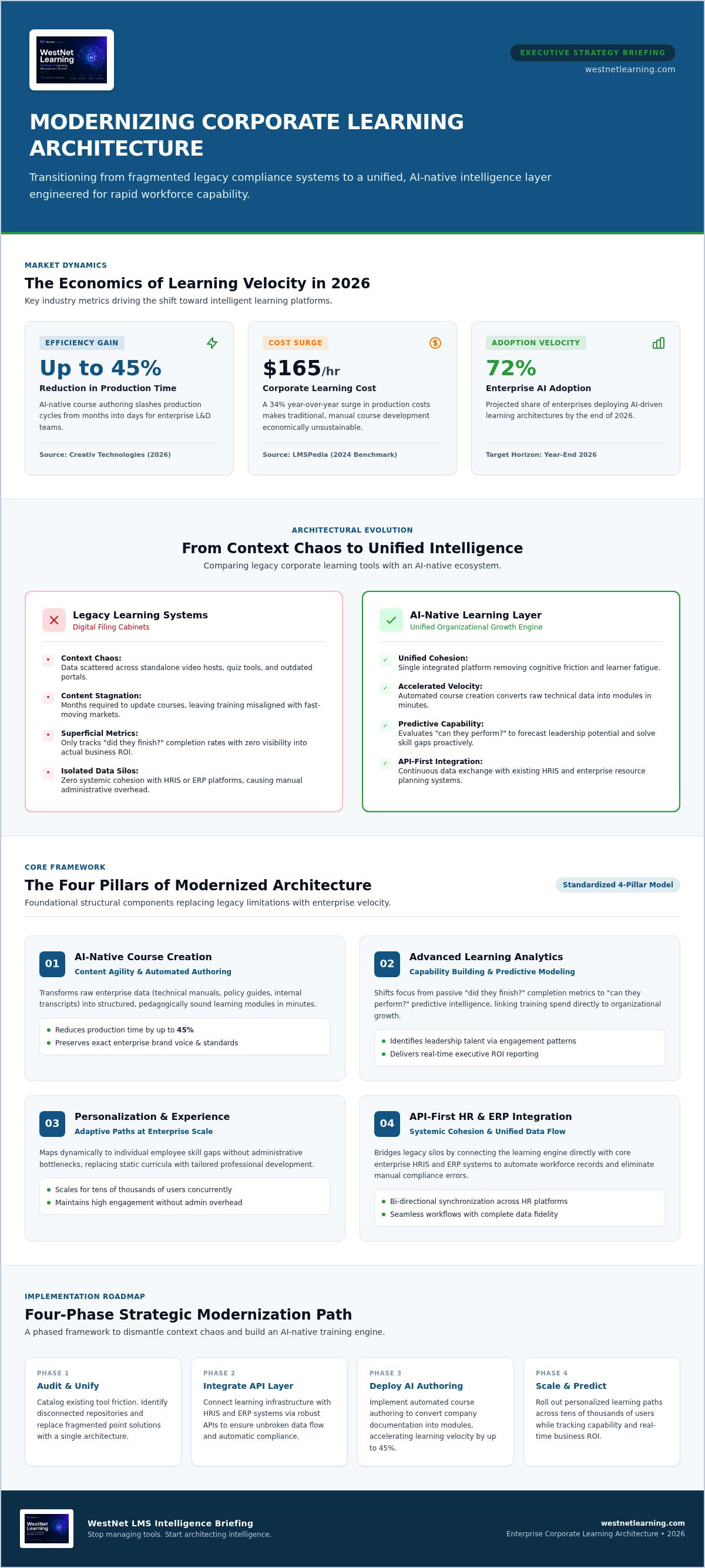
Market demands now outpace traditional instructional design cycles. According to LMSPedia, the cost per corporate learning hour rose to $165 in 2024, which is a 34 percent year-over-year increase. This financial pressure makes slow development cycles unsustainable. Legacy systems that lack AI-native authoring leave companies trapped in a state of content stagnation. Learning Velocity is the new competitive benchmark. It measures how quickly an organization can transform new information into workforce capability. With 72 percent of enterprises expected to adopt AI-driven platforms by the end of 2026, those relying on manual updates will find themselves at a severe disadvantage. If your system takes months to deploy a course that should take days, you're losing the race for talent and efficiency.
The Pillars of a Modernized Learning Architecture
Modernization requires more than a superficial upgrade. It demands a structural shift toward a unified intelligence layer. True success in modernizing corporate learning systems depends on four foundational pillars that bridge the gap between legacy limitations and future-ready performance. You can't simply bolt AI onto a twenty-year-old framework and expect modern results. You need an architecture built from the ground up for speed, precision, and integration. This foundation allows organizations to move beyond reactive training and toward proactive workforce development.
Pillar 1: AI-Native Course Creation
Automated authoring tools now transform raw enterprise data, such as technical manuals or internal transcripts, into structured, pedagogically sound modules within minutes. This shift eliminates the manual bottleneck of traditional instructional design. AI ensures every module maintains your specific brand voice while adhering to rigorous educational standards across the entire organization. AI-native tools are currently reducing eLearning production time by up to 45 percent for enterprise L&D teams, according to data from Creativ Technologies in 2026. AI-native authoring is the engine of content agility. By utilizing these tools, teams can respond to market shifts in real time without increasing their administrative headcount.
Pillar 2: Advanced Learning Analytics
Legacy systems focus on completion rates. Modern architectures focus on capability building. Advanced analytics move beyond the "did they finish?" metric to ask "can they perform?" Predictive models now identify future leadership talent by analyzing engagement patterns and long-term knowledge retention rates. Real-time reporting provides executive decision-makers with the clarity needed to align training spend with actual business outcomes. This centralizes intelligence, allowing for a proactive strategy that anticipates skill gaps before they impact the bottom line.
Pillar 3: Personalization and Experience
Scalability often comes at the cost of the individual experience. AI-native systems solve this by creating AI-powered learning paths that map directly to individual skill gaps. This ensures every employee receives the exact training they need exactly when they need it. Research from Creativ Technologies shows that AI personalization on LMS platforms can lead to a 26 percent higher knowledge retention rate. When you combine this precision with gamification, training transforms from a requirement into an immersive experience. Strategic architects use these pillars to build systems that don't just store information but actively empower a workforce. If you're ready to see how these pillars function in a live environment, explore the WestNet AI LMS to witness the future of unified intelligence.
Bridging the Gap: Integrating AI with Existing HR Ecosystems
Modernization is not an isolated event. It requires deep synchronization between your learning infrastructure and the broader enterprise tech stack. For many organizations, the gap between the Human Resource Information System (HRIS) and the learning platform is a source of constant friction. Modernizing corporate learning systems effectively requires an API-first approach that ensures data flows seamlessly across the organization. This connectivity eliminates the manual data entry that often leads to reporting errors and administrative burnout. When your systems talk to each other, you move from managing tools to orchestrating intelligence.
Seamless workflows are essential for adoption. Implementing Single Sign-On (SSO) removes the barrier of multiple passwords, allowing employees to access training in the flow of work. This integration ensures that learning isn't a destination but an integrated part of the daily professional experience. By reducing the steps required to access content, you directly improve engagement and retention across the workforce.
The Strategic Importance of HRIS Integration
Automated data synchronization is the backbone of a modern learning strategy. By connecting your LMS to your HRIS or ERP, you ensure that new hires are automatically enrolled in relevant paths and that role changes trigger immediate updates to learning requirements. This mapping of learning progress to performance reviews provides a clear line of sight from skill acquisition to career advancement. WestNet LMS excels here by offering robust LMS Integrations that support seamless connectivity with your existing tech stack. This cohesion allows leadership to view talent development as a measurable component of the broader business strategy rather than a disconnected silo.
AI Safety and Data Privacy in 2026
As AI agents become more autonomous, security must be a primary concern for every strategic architect. The rise of sophisticated AI brings the risk of accidental data leakage if the system is not properly governed. In 2026, enterprise-grade security is non-negotiable. Organizations must adhere to strict standards, including SOC2 compliance and end-to-end data encryption, to protect sensitive employee information. Systems must be designed to prevent "rogue bots" from accessing or sharing unauthorized data.
Regulatory compliance is also evolving rapidly. As of August 2, 2026, supervisory bodies for the EU AI Act are in effect, requiring companies to ensure their staff possess sufficient AI literacy. Additionally, California's Assembly Bill 1159 prohibits the use of student data to train AI models. A modern system must respect these boundaries while providing the benefits of automation. By prioritizing safety and privacy, you build a foundation of trust that allows your workforce to engage fully with AI-driven development tools.
Executing the Modernization: A Phased Implementation Roadmap
Modernization is a tactical deployment, not a software installation. You must treat the transition as a strategic architectural project. Modernizing corporate learning systems requires a disciplined, four-phase approach to ensure systemic adoption and measurable ROI. This journey begins with an honest assessment of your current state and ends with a self-optimizing intelligence ecosystem. It's a path that moves your organization from "context chaos" to "unified intelligence" by replacing legacy debt with future-ready infrastructure.
Step 1: The Infrastructure Audit
Identify the "zombie" systems currently draining your resources. These legacy platforms often persist due to inertia, offering low engagement while consuming significant portions of the L&D budget. A Modernization Audit is the definitive first step toward operational clarity. During this phase, evaluate your existing content library for AI-driven migration potential. AI-native tools can now repurpose static documents into interactive modules with minimal manual intervention. If a tool doesn't contribute to your "Learning Velocity," it doesn't belong in your 2026 roadmap. Eliminate the waste to make room for innovation.
Step 2: Securing Executive Buy-In
Translate technological advantages into financial outcomes for the C-Suite. In 2026, enterprise LMS buyers pay an average of $70,614 per year, making every efficiency gain critical for the bottom line. Build your business case around the 45 percent reduction in eLearning production time made possible by AI authoring. This isn't just a "nice-to-have" feature; it's a fundamental shift in how capital is deployed. Use early analytics from your pilot programs to prove that modernization reduces the cost per learning hour while increasing workforce capability. Show them the data. Secure the budget. Drive the change.
Phase 2 focuses on selecting an AI-powered LMS platform that scales. Look for systems that offer native AI course creation rather than bolted-on plugins. This distinction is vital for maintaining a unified data ecosystem across your entire enterprise. In Phase 3, launch pilot programs to secure stakeholder alignment. These smaller deployments allow you to iron out integration wrinkles before the full-scale rollout in Phase 4. Continuous optimization ensures the system evolves alongside your workforce, using real-time feedback to refine delivery. To begin your transition with a proven partner, explore the WestNet AI LMS roadmap and eliminate the friction of legacy debt.
Scaling Corporate Intelligence with WestNet AI LMS
Modernizing corporate learning systems demands a partner that understands both the strategic architect's vision and the logistical reality of large-scale operations. WestNet AI LMS provides that bridge. It replaces the friction of fragmented tools with a unified intelligence ecosystem that scales with your ambition. We help you move beyond simple training management into a state of systemic empowerment where every data point informs a better business outcome. By centralizing your learning infrastructure, we eliminate the operational obstacles that once hindered growth.
The WestNet Advantage: Sophistication Simplified
The WestNet advantage lies in our ability to simplify sophistication. Our AI Course Creation engine allows your team to reduce development cycles by up to 70 percent, significantly outperforming industry averages through highly optimized automation. This speed doesn't sacrifice quality or brand integrity. Every module adheres to your specific pedagogical standards while remaining fully integrated with our advanced analytics suite. You gain the ability to track ROI in real time, moving from speculative training to data-driven capability building that leadership can trust. Our platform turns raw data into structured, actionable knowledge with minimal manual intervention.
Modernize your learning ecosystem with a free 30-day WestNet trial and experience the seamless transition from context chaos to unified intelligence.
Future-Proofing Your Workforce
Scalability is not just about user count; it's about maintaining precision at a massive volume. WestNet AI LMS personalizes development for tens of thousands of users simultaneously, ensuring each individual receives a unique path mapped to their specific skill gaps. We utilize sophisticated gamification to turn passive learning into an active, immersive experience. This drives the long-term engagement necessary for a truly agile workforce. As your organization evolves, our platform scales with you, integrating seamlessly through our robust LMS Integrations to maintain a single source of truth across your entire tech stack.
Future-proofing requires more than just new features; it requires continuous systemic improvement. The result of this architectural shift is a modernized enterprise that is agile, intelligent, and empowered to handle the complexities of 2026 and beyond. Trust in a stabilizing force that handles complexity with ease. Build your future on a foundation of technological optimism and strategic clarity. The path to organizational intelligence is clear, direct, and ready for your execution.
Architecting the Future of Organizational Intelligence
Modernizing corporate learning systems is a foundational requirement for any enterprise seeking a competitive edge in 2026. You've seen how a unified architecture eliminates the friction of legacy debt and replaces it with an AI-native ecosystem that scales effortlessly. By prioritizing seamless integration and predictive analytics, you can transform training from a cost center into a strategic engine for growth.
The transition from fragmented tools to a cohesive intelligence layer is within your reach. WestNet AI LMS provides the stabilizing force needed to handle this complexity, offering AI-powered course authoring and advanced enterprise analytics that support over 10,000 users simultaneously. It's time to empower your workforce with a platform designed for the speed of modern business.
Request a Demo of WestNet AI LMS and begin your journey toward unified intelligence today. Your organization's potential is limitless when supported by the right architecture.
Frequently Asked Questions
What are the first steps in modernizing a corporate learning system?
Modernization begins with a strategic infrastructure audit to identify resource-draining "zombie" systems. You must evaluate your existing content for AI-driven migration potential and align your goals with core business objectives. Defining clear KPIs for "Learning Velocity" ensures that your roadmap remains focused on measurable growth. This initial clarity allows you to transition from fragmented tools to a unified architecture without disrupting current operations or sacrificing instructional quality.
How does AI improve the efficiency of an LMS?
AI enhances efficiency by automating the most time-consuming aspects of training management. AI-native authoring tools can reduce course development time by up to 45 percent, allowing L&D teams to respond to market shifts in real time. Additionally, predictive analytics identify skill gaps and leadership potential before they become operational obstacles. These automations remove administrative burdens, enabling your team to focus on high-level strategy rather than manual data entry or repetitive content updates.
Can a modern LMS integrate with our existing HRIS?
Yes, a modern platform is designed with an API-first architecture to ensure seamless connectivity with your existing HRIS or ERP ecosystem. These LMS Integrations allow for automated data synchronization, which reduces manual entry errors and ensures that employee records stay updated across all systems. Mapping learning progress directly to performance reviews within your HRIS provides a holistic view of workforce development. This systemic cohesion is a cornerstone of modernizing corporate learning systems effectively.
What is the difference between a legacy LMS and an AI-native platform?
Legacy systems often function as static digital filing cabinets that focus primarily on compliance and completion tracking. In contrast, an AI-native platform like WestNet AI LMS acts as a proactive intelligence engine. It uses machine learning to personalize development paths and automate content creation. While legacy tools create "context chaos" through fragmented data, AI-native systems provide a unified layer of intelligence that adapts to the specific needs of every individual user.
How do we measure the ROI of a modernized learning system?
Measuring ROI requires moving beyond simple completion rates to track tangible capability building and operational efficiency. You should analyze the reduction in course development costs and the increase in knowledge retention rates, which often rise by 26 percent with AI personalization. Advanced analytics also allow you to correlate training milestones with actual performance improvements on the job. These data points provide a clear financial justification for your investment in modernizing corporate learning systems. It's a measurable path to success.
Is AI course creation secure for sensitive corporate data?
Enterprise-grade AI systems prioritize data security through robust encryption and strict adherence to SOC2 compliance standards. Modern platforms are built to prevent data leakage and ensure that AI models aren't trained on sensitive proprietary information. By following regulatory frameworks like the EU AI Act and California's Assembly Bill 1159, these systems provide a secure environment for automated authoring. You can leverage the power of automation while maintaining total control over your organization's intellectual property.
How long does it typically take to migrate to a modern LMS?
Migration timelines vary based on organizational scale and the complexity of existing data, but a phased approach typically takes several months. Utilizing AI-driven migration tools can significantly accelerate the process by automating the conversion of legacy content into modern formats. Starting with a pilot program allows you to identify potential integration challenges early, ensuring a smoother full-scale rollout. This methodical progression minimizes downtime while maximizing the long-term impact of your new intelligence ecosystem.
What features are essential for an enterprise-grade learning system in 2026?
An enterprise-grade system in 2026 must feature AI-native course authoring, advanced predictive analytics, and the ability to scale for tens of thousands of users. Seamless LMS Integrations and Single Sign-On (SSO) are essential for reducing user friction and ensuring systemic cohesion. Additionally, gamification and personalized learning paths are critical for driving the engagement levels required by a modern workforce. These features work together to create a stabilizing force that supports continuous organizational growth.