What if a badge recognized a skill employees could actually apply, rather than simply marking another completed course? Choosing a corporate learning platform with gamified badges means looking beyond visual rewards. Badges need clear criteria and meaningful milestones, while leaderboards should encourage participation without making learners feel left behind. Recognition should support learning, not distract from it.
This guide offers a practical framework for evaluating badge design, learner experience, reporting, and fit with your existing programs. You’ll learn how to distinguish badges for course completion from those tied to specific skills or progress, consider how different learners respond to competition, and compare gamification alongside administration and analytics. We’ll also cover how enrollment workflows and learner recommendations fit into the bigger picture, plus what to test in a demo or trial. The goal is a confident decision based on how the platform supports learning from enrollment through measurable progress.
Key Takeaways
- Assess a corporate learning platform with gamified badges by how well recognition supports learning goals, not by the number of game features it offers.
- Use clear, evidence-based criteria to distinguish course completion recognition from badges intended to represent skills or knowledge.
- Compare learner visibility, administration, and reporting alongside badge features to understand the platform’s operational fit.
- Test a sample learner journey from both the learner and administrator perspectives before making a decision.
- See how WestNet AI LMS brings leaderboard and badge gamification together with learning analytics, reporting, and automated enrollment.
Why choose a corporate learning platform with gamified badges?
Choose recognition features that reinforce the learning goal, not ones that compete with it. In a corporate learning platform with gamified badges, a badge should make progress or achievement visible while the course, practice, or assessment remains the substance of learning. A badge for finishing a module serves a different purpose from one awarded after a learner demonstrates a specific skill. Define what the recognition is meant to communicate before evaluating the feature.
LMS gamification adds structured game elements to a learning experience. These may include badges, points, progress indicators, challenges, or leaderboards, used to help learners see milestones and engage with learning activities. The Gamification of Learning overview discusses how these approaches can be used in learning contexts. Keep the design purposeful: an element earns its place when it supports a clear objective and makes the learning journey easier to understand.
What do badges add to employee training?
A badge is a visible recognition marker tied to a defined learning milestone or achievement. It records recognition, but it is not the learning activity or assessment itself. For example, completing a safety module might earn a completion badge, while a badge intended to represent skill should be tied to evidence that the learner met stated criteria. This distinction helps employees understand what a badge means and prevents a completion marker from implying more than it demonstrates.
Badges can also make progress easier to recognize. A learner moving through a sequence of product training modules, for instance, can see which milestones are complete and what remains. That visibility may help learners orient themselves within a program, but a badge alone doesn’t establish that knowledge has been retained or that performance has changed. Treat it as one layer of recognition, supported by appropriate learning activities and assessment.
When are badges a useful fit for corporate learning?
Badges are a natural fit when a program has clear milestones and learner expectations. A structured onboarding pathway could recognize completion of defined stages, while optional development pathways could use badges to signal progress through selected courses or learning goals. For distributed teams, a consistent program can make milestones visible across locations. Approaches to connected learning for global teams also consider how learning is coordinated across a workforce.
Match recognition to the program’s purpose. Optional development benefits from badges that encourage exploration without making every course feel compulsory. Mandatory training has different requirements: employees need clear instructions about required activities and completion records, and a badge should not obscure those expectations. Decide whether recognition is informational, motivational, or evidence-based, then explain its meaning to learners.
Consider badges as one part of broader engagement design, not a stand-alone fix. If the objective is to acknowledge completion, use criteria learners can meet and understand. If the objective is to recognize demonstrated capability, connect the badge to an assessment or other defined evidence. That alignment gives employees a clearer reason to value the recognition and gives program owners a stronger basis for evaluating the platform.
How to design badge criteria learners can understand and trust
Start with the meaning of the recognition, then work backward to the course activity and evidence. Clear criteria make a badge easier for learners to value and easier for program owners to apply consistently. They also help prevent a completion marker from being mistaken for proof of skill.
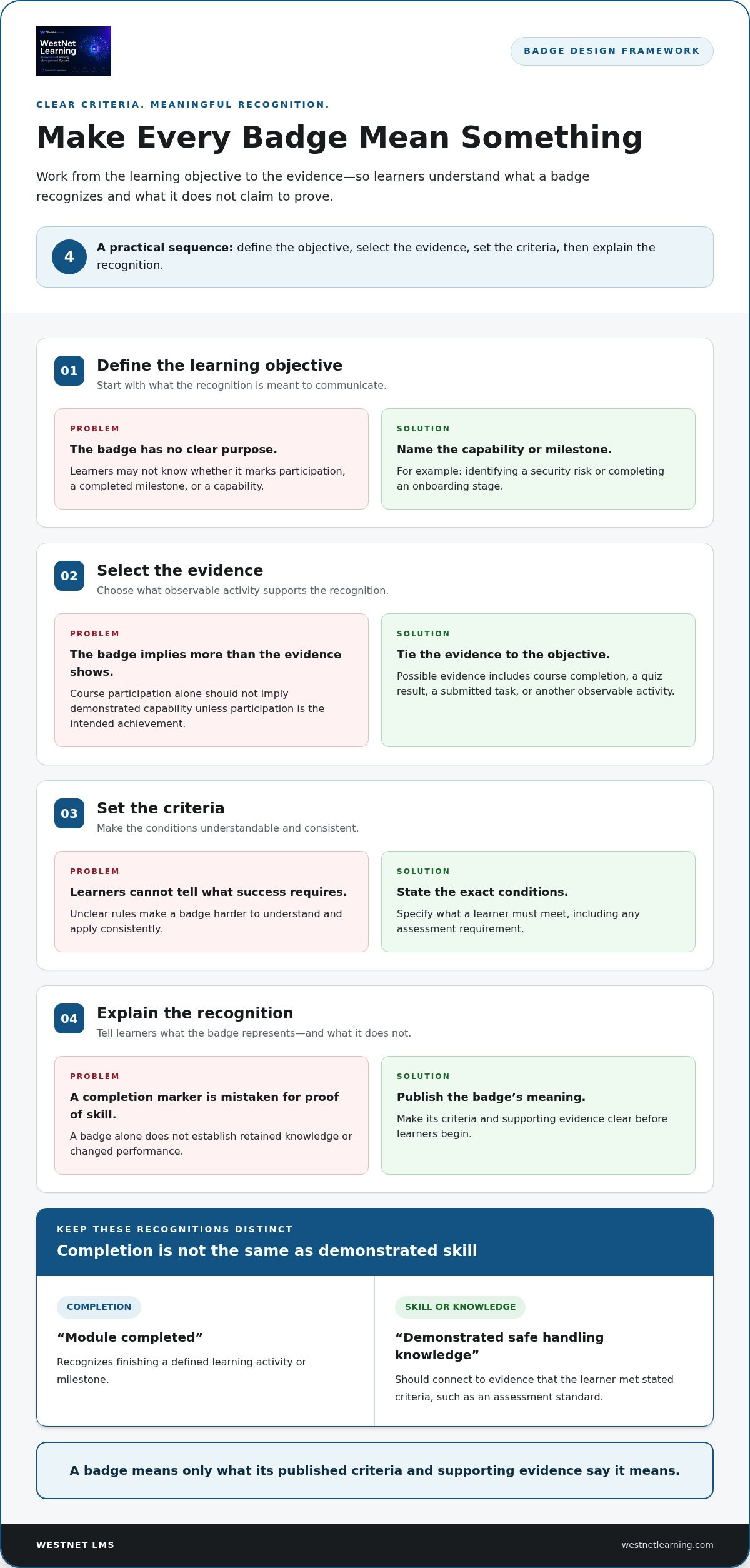
Use this four-step sequence to define each badge:
- Define the learning objective. Name the capability or milestone, such as identifying a security risk or completing an onboarding stage.
- Select the evidence. Decide what demonstrates progress: course completion, a quiz result, a submitted task, or another observable activity.
- Set the criteria. State the exact conditions a learner must meet, including any assessment requirement.
- Explain the recognition. Tell learners what the badge represents and what it does not claim to prove.
A badge means only what its published criteria and supporting evidence say it means. Keep those details concise and available before learners begin, so they know what success looks like and can make informed choices about their effort.
Map each badge to an observable learning milestone
Connect the badge to a milestone that can be clearly observed. If the goal is to recognize participation, say so: completing a course or attending a learning activity may be the stated milestone. If the badge is intended to represent a skill, define the evidence that supports that claim, such as meeting a stated assessment standard. Participation alone shouldn’t imply demonstrated capability unless participation itself is the intended achievement.
Separate completion badges from skill or knowledge badges in both their names and descriptions. For example, “Module completed” communicates a different achievement from “Demonstrated safe handling knowledge.” The distinction supports transparent recognition and helps managers interpret badges consistently.
Make badge rules visible and consistent
Write learner-facing rules in direct language. Explain eligibility, required activities, assessment conditions, and how the badge is awarded. Avoid vague phrases such as “show strong understanding” unless you define what that looks like. When similar courses or roles use comparable milestones, align their badge names and criteria where appropriate so learners aren’t left guessing why expectations differ.
Course workflows shape the activities behind each milestone. If course content is being developed or converted, course conversion workflows can be considered alongside the objectives and evidence that badges will represent. Keep the sequence coherent: teach the capability, give learners a suitable way to demonstrate it, then award recognition according to the published rule.
Before rolling out a badge, review its description from a learner’s perspective: Could someone tell what they need to do, what evidence counts, and what the badge signifies? If the answers are unclear, tighten the criteria first. A corporate training LMS can provide the broader learning environment for organizing activities and recognition, while the badge rules give each marker its meaning.
How to compare corporate learning platforms with gamified badges
Compare the badge experience with the platform’s ability to support everyday learning operations. A corporate learning platform with gamified badges should fit the way your organization assigns training, manages learners, and reviews progress. Don’t let a long feature list make the decision for you. Identify your requirements, then evaluate each platform against the workflows your team will use.
Use this matrix to structure the comparison. Record what you observe in the platform separately from questions that need further evaluation.
| Evaluation area | What to compare | What to test or clarify |
|---|---|---|
| Badge criteria | Whether the platform includes badge recognition and how it relates to your program rules. | Can administrators apply the intended criteria, and can learners understand what each badge signifies? |
| Learner visibility | How learners encounter badge information and view their learning progress. | Is badge meaning clear at the point learners need it? Can they see what remains in a learning pathway? |
| Administration | How training assignments, enrollment, and recognition fit into administrative workflows. | Can your team manage the process across relevant learner groups without creating inconsistent rules? |
| Reporting | What learning analytics and reporting are available for reviewing program activity. | Can you examine the information your team needs to assess participation and learning progress? |
| Platform fit | How the LMS aligns with your organization’s wider systems and processes. | How do authentication, HRIS integration, and data migration fit your requirements? |
Compare learner experience and administrator control
Walk through the process from both sides. As a learner, can you tell what a badge represents and where it fits in your progress? As an administrator, can you assign courses, manage enrollment, and maintain criteria across teams or roles? Use a realistic learner group and course pathway in the demo. This reveals workflow friction that a feature checklist can miss, especially when different departments need consistent recognition.
For example, WestNet AI LMS includes Gamification - Leaderboard and badges, Learning Analytics and Reporting, and automated enrollment. Use these features as a starting point for evaluating how learner recognition, reporting, and enrollment fit your organization’s badge rules and workflows.
Evaluate reporting, access, and system fit
Reporting should help your team evaluate learning activity, not simply display a badge count. Consider which views would help you identify participation patterns, review progress, or decide whether a program needs adjustment. This is where enterprise learning analytics tools can inform a broader approach to program evaluation.
Badges alone don’t establish learning quality or prove business impact. Review the underlying course and assessment, then consider whether reporting gives decision-makers useful evidence for the questions they’re trying to answer. Include authentication, HRIS integration, and migration in the same platform-fit review, and examine how the relevant workflows operate.
How to evaluate a badge-enabled LMS before making a decision
Run a practical test, not just a feature tour. Before evaluating a corporate learning platform with gamified badges, choose one real learning objective and map a sample learner’s journey from enrollment to recognition. This repeatable approach reveals whether the badge experience works for learners and administrators, and whether it fits the broader training environment.
Write down your requirements first: the objective and badge criteria, relevant integrations, language needs, enrollment process, and the decision factors that matter most to your organization. Separate essential requirements from preferences. That record gives your evaluation team a consistent basis for comparing what you observe rather than relying on impressions from a polished presentation.
Run a realistic badge workflow during evaluation
Select a representative course and define the milestone the badge should recognize. Then follow the journey in sequence, from enrollment and learning activity to the point when the learner sees the recognition. Review the criteria from both perspectives: can learners understand what they must do, and can administrators apply the rule clearly and consistently?
Use a checklist to capture specific observations:
- Learner view: Is the badge’s meaning and the next step clear?
- Administrator workflow: Can the team manage enrollment and recognition in a repeatable way?
- Criteria: Does the test reflect the intended milestone, rather than imply evidence it doesn’t collect?
- Reporting: Can reviewers find information relevant to the program’s goals?
Ask more than one administrator to review the process. If they interpret a rule differently, refine the criteria or learner-facing explanation before treating the workflow as ready. WestNet AI LMS includes Gamification - Leaderboard and badges, Learning Analytics and Reporting, and automated enrollment. A demo or free 30-day trial gives decision-makers a way to explore these features in the context of their own evaluation.
Assess the platform in the wider training environment
Test the badge journey alongside the operational requirements surrounding it. Review enrollment steps, relevant reports, and administrator tasks, then consider how HRIS integration, data migration, authentication, and support needs apply to your organization. A corporate training LMS demo guide can help structure a broader walkthrough, while a corporate LMS adoption framework can inform rollout planning and learner participation.
Close the evaluation by scoring each requirement as met, needs further review, or not met. Note the evidence behind each rating, such as a completed learner workflow or a reporting view examined during the test. This makes trade-offs visible to stakeholders and keeps badge appeal in proportion to usability, administration, and system fit. Explore WestNet’s LMS options as you plan your evaluation.
How WestNet AI LMS brings badges into corporate learning
WestNet LMS brings badge recognition into a broader corporate learning environment. Its Gamification - Leaderboard and badges feature sits alongside Learning Analytics and Reporting and automated enrollment, connecting learner recognition with program administration and review. That wider context matters: a badge can acknowledge a milestone, while the platform also supports the workflows around training.
For decision-makers evaluating a corporate learning platform with gamified badges, consider how these capabilities relate to your program goals. Automated enrollment can support the process of assigning learners to training, while Learning Analytics and Reporting gives administrators a place to review learning information. The platform also includes AI-Generated Course Recommendations for learners. This separate capability can support course discovery, but it is not a badge rule or proof of skill.
Connect badges with administration and learner support
Site Setup & Preferences includes training badges, bringing badge setup into the platform’s administrative context. During an evaluation, use your planned recognition criteria to examine how this configuration fits the learner experience and the way your team manages training. A clear operating process can help administrators apply recognition consistently as learning programs expand.
The platform also includes a Dedicated Client Success Manager. It supports up to 60 site languages, which can be relevant for organizations operating across language environments. This is a site-language capability, not a claim that course content is automatically translated. Consider language needs separately when planning course materials and learner communication.
Evaluate WestNet LMS against your requirements
Bring the criteria and workflow developed during your evaluation into a WestNet demo or free 30-day trial. Start with one learning objective and check whether the badge’s intended meaning is clear. Then walk through the learner’s experience, review the administrative steps for enrollment and badge setup, and examine Learning Analytics and Reporting in light of the questions your team needs to answer. This keeps the review grounded in your program rather than a generic feature tour.
Use your requirements list to assess the whole platform, not just gamification. Compare the badge workflow with your enrollment process, reporting needs, and learner support expectations. Note which requirements the platform addresses and which details you want to explore hands-on. This structured approach can help stakeholders make a decision based on operational fit as well as recognition features.
If you’re ready to see how the platform fits corporate training workflows, explore WestNet LMS for corporate training. Then take the next step and start a WestNet LMS evaluation through a demo or free 30-day trial.
Put your learning goals into action
The next step is to turn your badge criteria into a decision your team can confidently support. Choose a learning priority, agree on what meaningful progress would look like, and use that shared objective to guide your platform evaluation. This keeps the conversation focused on the value recognition should create for learners and the organization, rather than on gamification features in isolation.
A corporate learning platform with gamified badges should fit the learning experience you intend to build and the way your team needs to manage it. Bring the people responsible for learning strategy, administration, and learner experience into the evaluation so each perspective informs the decision. Then test the platform against the criteria that matter most to your programs.
Take that next step with WestNet AI LMS. Evaluate WestNet AI LMS with a demo or free 30-day trial, and explore how your learning goals can take shape in a connected corporate learning environment. Build recognition with purpose and move forward with confidence.
Frequently Asked Questions
What is a corporate learning platform with gamified badges?
A corporate learning platform with gamified badges is an LMS that incorporates digital recognition into employee training. A badge can acknowledge a defined activity or achievement, while the platform provides the environment for delivering and managing learning. For example, a company might recognize completion of a product knowledge pathway. The badge is a marker of that milestone, not a substitute for the course, practice, or assessment that supports it.
Do gamified badges improve employee training outcomes?
Badges don’t guarantee better training outcomes on their own. Their value depends on whether learners find the recognition meaningful and whether the learning activity supports a real objective. To assess their contribution, compare relevant indicators before and after introducing badges, such as participation in optional courses or assessment results. Consider other changes to the program too, so you don’t attribute every difference to the badge feature.
Can corporate LMS badges represent skills, not just course completion?
Yes, if the badge criteria are tied to evidence of the skill rather than attendance or course completion alone. For example, a customer service badge could require a learner to pass a scenario-based assessment against defined standards. The badge description should make clear what evidence was assessed and avoid suggesting broader expertise than the criteria support. This lets managers and learners interpret the recognition responsibly.
How should a company decide what earns a learning badge?
Start by asking what the organization wants the badge to communicate and who will use that information. A subject-matter expert can help distinguish a meaningful capability from a simple activity milestone. Then decide what evidence is practical to collect and document who owns the criteria. For a new product launch, for instance, teams might recognize completion of required learning separately from passing a knowledge check.
Are leaderboards necessary for a corporate learning platform with badges?
No. Badges can recognize individual milestones without ranking employees against one another. Leaderboards add a comparative element, which may suit a voluntary challenge but feel less appropriate for sensitive training or teams with different roles. Decide whether comparison supports the program’s purpose, and consider how employees will interpret rankings. Evaluate badge capability and leaderboard features as distinct design choices.
What should I test in a demo of a badge-enabled LMS?
Test a complete learner scenario, including what happens when a learner meets the criteria, doesn’t meet them, or needs to repeat an activity. Check whether the badge’s meaning is understandable without an administrator explaining it. Then review how an administrator handles a criteria change and whether relevant learning information can be found in reporting. These edge cases can reveal workflow needs that a standard feature presentation may not show.
Can badges work for compliance training?
Yes, badges can provide an additional recognition marker for a compliance learning milestone, such as completing an assigned course or passing its knowledge check. Keep the badge’s purpose clear and use the organization’s established training records and reporting processes for monitoring completion. A badge shouldn’t replace required documentation or imply that a learner has met obligations beyond the evidence the training activity records.