What if more effective workplace training depends less on adding content and more on designing around how people think and remember? Cognitive learning theories offer practical ways to understand how learners process information, connect it to what they already know, and retrieve it later.
If academic explanations make these theories seem difficult to distinguish, you’re not alone. Turning abstract ideas into digital courses can also be challenging: you want to hold attention without overwhelming learners or leaving them unsure what to remember.
This guide clarifies core cognitive concepts and shows how they can inform workplace learning. You’ll explore how attention, working memory, prior knowledge, and recall shape the learning experience, then see how to apply those principles to course structure, content, and practice.
Build training with purpose. Connect learning theory to practical digital design to create clearer experiences that help employees make sense of new information and use it at work.
Key Takeaways
- See how cognitive learning theories explain the mental processes behind attention, memory, and reasoning.
- Compare information-processing, schema, cognitive load, and constructivist perspectives to identify what each can contribute to workplace training.
- Use a practical design sequence to build on learners’ prior knowledge, organize course content, and check understanding.
- Reduce avoidable mental effort by chunking complex material, choosing meaningful examples, and limiting distracting presentation elements.
- Explore how an LMS can organize learning and provide relevant learner recommendations, AI-powered help, and reporting.
What Are Cognitive Learning Theories? Understand Learning from the Inside Out
Cognitive learning theories explain how people attend to, interpret, remember, and use information. They focus on the mental activity behind learning, not only on what a learner does where others can see it. A completed quiz or correctly performed task is observable; the understanding, memory, and reasoning behind it are internal.
This distinction matters in employee training. If a learner makes an error, repeating the instruction may not solve the problem. They may have missed a key detail, misunderstood a term, or struggled to connect a new procedure with what they already know. Cognitive learning theories help course designers consider these possibilities and support understanding, not just task completion. The Cognitivism (psychology) overview provides additional context on this perspective and its focus on mental processes.
Which mental processes do cognitive theories examine?
These theories examine related processes that shape how learners make sense of information:
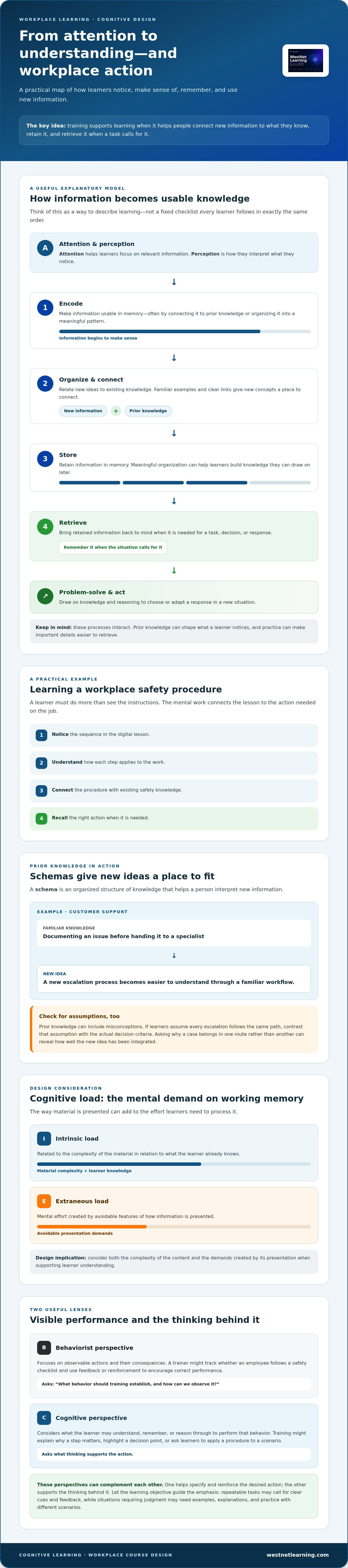
- Attention helps learners focus on relevant information. Perception is how they interpret what they notice.
- Encoding is the process of making information usable in memory, often by connecting it to prior knowledge or organizing it into a meaningful pattern.
- Memory and retrieval involve retaining information and bringing it back to mind when needed.
- Problem-solving draws on knowledge and reasoning to choose or adapt a response in a new situation.
Consider an employee learning a new safety procedure. They need to notice the sequence in a digital lesson, understand how each step applies to their work, connect it with existing safety knowledge, and later recall the right action. These processes interact: prior knowledge can shape what the employee notices, while practice can make key details easier to retrieve. They’re useful concepts for designing a course, not isolated stages that every learner moves through in a fixed order.
For employees working across different locations, consistent terminology and clear explanations can establish a shared reference point. This is also relevant to training across global teams, where learners may encounter the same information in different work contexts.
How do cognitive theories differ from behaviorist explanations?
Behaviorist explanations focus on observable actions and the consequences that follow them. For example, a trainer might track whether an employee follows a safety checklist and use feedback or reinforcement to encourage correct performance. This perspective helps answer, “What behavior should training establish, and how can we observe it?”
A cognitive perspective asks what the learner may understand, remember, or reason through to perform that behavior. It can guide decisions such as explaining why a step matters, highlighting a decision point, or asking learners to apply the procedure to a scenario. The approaches can complement each other: one helps specify and reinforce the desired action, while the other supports the thinking behind it.
Neither perspective answers every instructional question. Let the learning objective guide the emphasis. A straightforward, repeatable task may call for clear cues and feedback, while a situation requiring judgment may need examples, explanation, and practice with different scenarios. Distinguishing visible performance from the mental processes that support it gives training teams a clearer basis for course decisions.
How Cognitive Learning Theories Explain Memory, Knowledge, and Understanding
Learning is active. Employees interpret new information through what they already know, connect related ideas, and decide what matters for a task. Presenting content, then, isn’t the same as supporting understanding. A learner may see a new workflow but still need clear links to familiar tools, terms, or decisions before the steps make sense.
A useful way to describe this activity is as a sequence: information is encoded into a form the learner can work with, organized and connected to existing knowledge, stored in memory, and later retrieved for use. Treat this as an explanatory model, not a fixed checklist. Learners may revisit information, make new connections, or discover gaps as they apply their knowledge.
How schemas help learners organize new information
A schema is an organized structure of knowledge that helps a person interpret new information. In workplace learning, an employee who understands basic customer-support workflows may learn a new escalation process more easily when the course connects it to familiar actions, such as documenting an issue before handing it to a specialist. Familiar examples give new concepts a place to connect.
Prior knowledge can also include misconceptions. If employees assume every escalation follows the same path, a course should contrast that assumption with the actual decision criteria. Ask learners to explain why a case belongs in one route rather than another. Their reasoning can reveal whether they have integrated the new idea or merely repeated it.
How cognitive load affects learning and recall
Cognitive load is the mental demand placed on working memory while a person processes information. Cognitive load theory distinguishes intrinsic load, related to the complexity of the material in relation to a learner’s existing knowledge; extraneous load, created by avoidable features of how information is presented; and germane load, the mental effort involved in building and refining useful knowledge structures. This framework is described in Sweller, van Merriënboer, and Paas’s scholarly article, “Cognitive Architecture and Instructional Design.”
Keep the distinctions practical. A multi-stage software workflow may have essential complexity because learners must coordinate several decisions. That demand is not automatically a design flaw. Dense screens, unexplained acronyms, or instructions separated from the task, however, can add avoidable effort. Organize related steps together, explain unfamiliar terms, and remove visual elements that compete with the lesson’s purpose.
Use examples and guided practice to help learners make sense of essential complexity, then check understanding with a task that requires them to apply the idea. If employees can only repeat a definition, they may not yet be able to use it. If they can explain a choice in a realistic scenario, you have a more useful signal of understanding and recall.
These principles can guide course structure and digital delivery. An AI-enhanced learning platform can bring course content, learner support, and practice into a coordinated experience. Keep instructional decisions grounded in the demands of the task and learners’ prior knowledge.
Cognitive Learning Theories Compared: What Each Explains Best
Theories of learning offer different lenses on how employees take in information, make meaning, and use what they learn. Comparing their central questions helps you choose design decisions based on the challenge at hand, rather than treating every framework as a competing recipe. These cognitive learning theories overlap, but each brings a different emphasis to course planning.
| Perspective | Central question | Useful training implication |
|---|---|---|
| Information-processing theory | How is information attended to, encoded, remembered, and retrieved? | Make key information clear and organized, then include opportunities to recall and apply it. |
| Schema theory | How does existing organized knowledge shape the interpretation of new information? | Connect new ideas to familiar examples, and surface misconceptions that could distort them. |
| Cognitive load theory | How do learning-task demands and presentation choices affect mental effort? | Manage unnecessary complexity in the presentation while supporting learners through essential task demands. |
| Constructivist perspectives | How do learners build understanding through experience and interpretation? | Use scenarios, reflection, and problem-solving to help learners develop and test their understanding. |
Information-processing and schema perspectives
Information-processing perspectives focus on how information moves through attention, encoding, memory, and retrieval. For a software tutorial, this lens might prompt a designer to emphasize a critical command and later ask learners to recall the sequence without simply replaying it. The central question is how to help learners take in and retrieve the information they need.
Schema theory shifts attention to the knowledge learners bring. A course introducing a new approval workflow might connect it to a familiar review process while clarifying where the new workflow differs. One perspective foregrounds how information is processed; the other highlights how prior knowledge shapes its meaning.
Cognitive load theory and constructivist perspectives
Cognitive load theory examines the mental demands involved in learning and how instruction can influence them. Constructivist perspectives emphasize learners’ active role in building understanding from experience and existing knowledge. Definitions and classifications can vary across scholarly sources, so treat these as useful lenses, not rigidly sealed categories. A realistic case can support active meaning-making, while its instructions still need to avoid unnecessary demands.
The perspectives can inform one course together. A learner might study a process, connect it to a familiar task, work through a realistic scenario, and receive a clear explanation of an error. Each design choice addresses a different aspect of learning. Select the lens that matches your instructional question, then combine compatible principles where useful.
Don’t treat a theory as a mandate for one universal method. A supposed learning-style label shouldn’t dictate that a learner must receive content in a single format. Instead, consider the objective, the learner’s starting knowledge, and the task’s demands. To support a procedure, prioritize clarity and recall. To build judgment, give learners opportunities to interpret cases and explain their decisions. The right design follows the learning need, not a fixed theory ranking.
Apply Cognitive Learning Theories to Workplace Course Design
Turn theory into a practical design process. Before building slides or quizzes, identify what employees already know, what they need to do, and what evidence will show they understand. This keeps a digital course focused on learning rather than simply delivering information.
Use this sequence to shape a course around attention, memory, and application:
- Identify prior knowledge. Ask what learners already understand about the topic and where assumptions may differ. For a new customer-data process, a short opening question can reveal whether employees know which information needs protection.
- Define the objective. Describe an observable task learners should be able to perform, such as selecting the correct next step in a data-handling scenario. A specific objective guides both the lesson and its assessment.
- Organize the content. Build from essential terms and concepts toward more demanding decisions. Break complex material into meaningful chunks, use examples that resemble real work, and remove decorative elements that compete with instructions.
- Check understanding. Add questions and practice throughout the course, then use responses to identify concepts that may need clearer explanation or another example.
Structure digital lessons to support attention and understanding
Give each module a clear learning goal and a brief scenario that explains why it matters. For example, a course on handling a customer-data request might begin with a realistic decision employees could face. Introduce unfamiliar terms before asking learners to apply them, and move from a worked example to a new case. Keep interactions purposeful: a decision prompt can reveal understanding, while an unrelated animation may distract from the task.
Chunking should clarify relationships, not just divide a long lesson into smaller screens. Group steps that belong together, label decision points, and place explanations close to the examples they clarify. If a task has several conditions, show how they connect before asking learners to choose an action independently.
Check learning with practice, retrieval, and feedback
Use low-stakes questions during the lesson to prompt recall and expose uncertainty while learners can still review the relevant material. Vary the task: ask learners to retrieve a key principle, choose a response to a scenario, or explain why one option fits better than another. Feedback should do more than mark an answer right or wrong. Explain the reasoning, point back to the relevant concept, and help learners understand how to approach a similar decision.
Interpret assessment results carefully. Course completion shows that a learner reached the end, not necessarily that they can apply the content. Look for patterns in missed questions to find where instructions, examples, or terminology may be creating friction. AI course creation software can support content-development workflows, while course objectives and review remain central to design. Learn about AI course creation software as part of that process.
Thoughtful course development also depends on how learning content is organized and delivered. WestNet LMS brings learning tools together in a digital platform.
Connect Cognitive Learning Principles to an AI-Enhanced LMS
Course design sets the learning intent; an LMS helps organize how that learning is delivered, practiced, supported, and reviewed. This system-level view matters because cognitive learning theories aren’t only ideas for individual lessons. They can also guide how learners find relevant courses, access help, and revisit material across a structured digital experience.
Technology supports the workflow, but it doesn’t make sound instructional decisions on its own. Clear objectives, accurate content, and practice aligned with the work remain essential. Use platform capabilities to deliver and examine those choices, not to assume that technology alone will produce learning.
Where WestNet AI LMS capabilities support learning workflows
WestNet AI LMS includes AI-Generated Course Recommendations for learners. Recommendations can help surface relevant learning within the platform, while course relevance and quality still depend on thoughtful content and learning goals. The system also offers AI-Powered Help for learners and admins, providing a support capability within the learning environment.
Learning Analytics and Reporting can help teams review participation and course activity. For example, if learners consistently leave a module at the same point or miss questions tied to one concept, that pattern may prompt a closer look at the lesson sequence, terminology, or practice. Activity data is a signal to investigate, not proof that learners have mastered a skill or a complete explanation of why they struggled.
Use analytics alongside learner feedback and assessment responses. A learner may complete a course but still find a key instruction unclear; another may revisit a section because it supports a complex task. Context helps learning teams interpret platform data responsibly and decide whether a course needs clarification, additional examples, or another opportunity to practice.
Keep instructional judgment at the center
Start with the learning objective and the demands of the task. Then select course content, examples, and checks for understanding that help employees build and use knowledge. An LMS can organize those elements and make them accessible, but it can’t replace human review of whether a process is accurate, an example is relevant, or an assessment measures the intended skill.
Make revisions deliberately. Compare learner feedback with course activity and assessment patterns, look for recurring points of confusion, and review the content before making changes. After an update, continue monitoring responses to see whether the change addressed the issue. This creates a considered improvement cycle rather than treating a single metric as a verdict.
WestNet Learning also provides a Dedicated Client Success Manager as a support feature for working with the learning platform. WestNet AI LMS features include tools for structured course delivery and learner support.
Put Cognitive Learning Principles Into Practice
Choose a course where learners need to make decisions, retain key information, or apply knowledge on the job. Use cognitive learning theories to review whether the learning experience supports that task, then consider how your platform can help deliver and refine it.
WestNet AI LMS brings together AI-Powered e-learning Creation, AI-Generated Course Recommendations for learners, and Learning Analytics and Reporting. These capabilities can support course-development and learning workflows, while your team remains responsible for clear objectives, accurate content, and thoughtful interpretation of learner activity. A Dedicated Client Success Manager is also part of the support model.
Start with a clear objective, build around the work employees need to do, and keep improving with purpose. Explore WestNet AI LMS to see how its capabilities could fit your organization’s learning approach.
Frequently Asked Questions
What are the main cognitive learning theories?
Commonly discussed cognitive learning theories include information-processing theory, schema theory, cognitive load theory, and constructivist perspectives. Information processing examines how people take in and use information; schema theory focuses on organized knowledge; cognitive load theory considers mental demands; constructivism emphasizes building understanding through experience. Each highlights a different aspect of learning. Choose a lens based on the question you’re investigating, and consult scholarly sources for formal definitions and distinctions.
How are cognitive learning theories used in employee training?
Instructional teams use cognitive principles to make workplace learning easier to follow and apply. They might introduce a new system by connecting its steps to a familiar workflow, then give employees a chance to recall the process and use it in a realistic decision. These design choices can support attention and application, but they don’t guarantee performance or retention. Review learner responses and workplace needs to decide whether the training is serving its purpose.
What is the difference between cognitive and social learning theories?
Cognitive theories focus on processes such as attention, memory, and how people organize knowledge. Social learning perspectives examine how people learn by observing others, modeling behavior, and participating in a social context. In a workplace course, employees might study a decision-making framework and also watch a colleague demonstrate how to use it in a team discussion. The perspectives can work together: learning involves internal thinking as well as interaction with people and the environment.
Can cognitive learning theories explain why people forget training?
Cognitive perspectives can help teams investigate how training information was attended to, understood, organized, and later brought to mind. They don’t identify one universal cause of forgetting or predict every learner’s experience. Consider whether employees had a chance to revisit the material, how much time passed before they needed it, and whether workplace cues help them recognize when to apply it. Use research to support specific explanations, and gather learner feedback before changing a course.
Do cognitive learning theories support learning styles?
Cognitive learning theories examine how people process information; they don’t require assigning each employee a permanent learning-style label. Rather than deciding that one person must always learn through video or another through text, choose formats that make the content accessible and fit the task. For example, a process may benefit from a concise written reference and a practice scenario. Base design choices on objectives, content, learner needs, and relevant evidence, not assumed style matching.
How can you tell whether a digital course supports cognitive learning?
Look for observable design choices: learners can identify the purpose, follow a sensible progression, work with relevant examples, and practice decisions with useful feedback. Check assessment responses for patterns, such as repeated errors on one question, and ask learners which instructions were unclear. Completion data alone only shows that the course was finished; it doesn’t demonstrate understanding. Use these signals to identify sections for review, then check whether revised materials address the confusion.
Are cognitive learning theories useful for online learning?
Yes. Cognitive theories can guide how an online course presents explanations, arranges navigation, and gives learners opportunities to work with information. For a troubleshooting course, for instance, learners might review a decision pathway, then select a next step in a simulated case. Online delivery doesn’t make any approach automatically effective. Match the format to the content and intended task, then evaluate learner responses and feedback to determine whether the design needs adjustment.