When employees need to take on new responsibilities, assigning more courses is not enough. An AI powered employee reskilling platform should help connect a defined capability need with relevant learning and useful evidence of progress. That takes more than AI-generated content or personalized recommendations alone.
Learning teams need a clear link between courses and employee development. As work changes, disconnected content and administrative processes can make it harder to identify what employees need next or assess whether learning is helping.
This guide offers a practical framework for evaluating platform capabilities, distinguishing learning delivery from workforce skills intelligence, and assessing fit before a broader rollout. It covers how course creation, learner recommendations, integrations, and reporting can work together. WestNet’s AI Enhanced LMS supports AI-powered e-learning creation and course recommendations, learning analytics, HRIS integration, and SCORM or xAPI course creation. A free 30-day trial lets teams evaluate real workflows before deciding on wider adoption.
Key Takeaways
- Distinguish reskilling for a role transition from upskilling within an employee’s current role so the learning objective is clear.
- Use the AI powered employee reskilling platform evaluation framework to assess how learning needs connect to content, recommendations, learner support, and evidence of progress.
- Compare content creation, analytics, integrations, and administration. Interpret outcome statistics in light of their methodology and relevance to your organization.
- Design a focused pilot around one role, learning need, and learner cohort. Record baseline measures such as enrollment, completion, feedback, and relevant assessments.
- Assess how a learning platform like WestNet’s AI Enhanced LMS supports delivery, while keeping learning activity distinct from standalone workforce skills intelligence.
What an AI-Powered Employee Reskilling Platform Needs to Solve
Work requirements shift as organizations adopt tools, change processes, or redistribute responsibilities. Training can fall out of step when courses are disconnected from those changes. An AI powered employee reskilling platform should help organize relevant learning around a defined capability need and make it easier to connect learning activities with employee development.
Definition: A reskilling platform supports learning delivery for changing job capabilities. Workforce planning identifies which capabilities the organization needs and where.
Reskilling and upskilling: two different learning goals
Reskilling prepares an employee for different responsibilities or a potential role transition. Upskilling develops capabilities that help someone perform more effectively in their current role. The distinction matters because the learning objective, content, and evidence of progress should match the intended change.
For example, a customer service employee moving toward a data-focused role may need capabilities that are not central to their current responsibilities. A colleague staying in customer service might instead learn to use a newly introduced support system. Both need learning, but the first is reskilling and the second is upskilling. Course completion or a recommendation alone does not prove readiness for new responsibilities.
Where a learning platform fits in workforce planning
Start with the work, not the course catalog. Leaders and managers identify a changing responsibility or capability gap, clarify which employees are affected, and decide what evidence would indicate progress. Learning teams can then select or create suitable content and assign development activities. AI features may help surface learning options or organize delivery, but they do not decide which roles the organization needs or replace human judgment about job requirements.
A practical sequence keeps the responsibilities clear:
- Define the business or role change and the capability it requires.
- Identify the employees and learning objective connected to that need.
- Select relevant courses or learning activities, then make them accessible.
- Review participation and assessment evidence alongside workplace context.
This distinction helps buyers assess platforms for learning delivery rather than assuming a recommendation engine is a complete workforce planning system. AI applications in education include approaches such as adaptive learning and personalized learning paths, as outlined in AI in Education. These capabilities can inform how learning is presented, while the organization remains responsible for defining the skills it needs and interpreting evidence of competence. For a broader view of how these capabilities fit into enterprise learning technology, explore the enterprise AI learning platform strategic guide.
How AI Connects Reskilling Needs to Learning Delivery
Once an organization has identified a capability need, the next challenge is turning it into a coherent learning journey. An AI powered employee reskilling platform can support content development, discovery, learner assistance, and reporting. Treat these as connected workflow capabilities, not proof that an algorithm has identified the right skill or confirmed an employee can perform it.
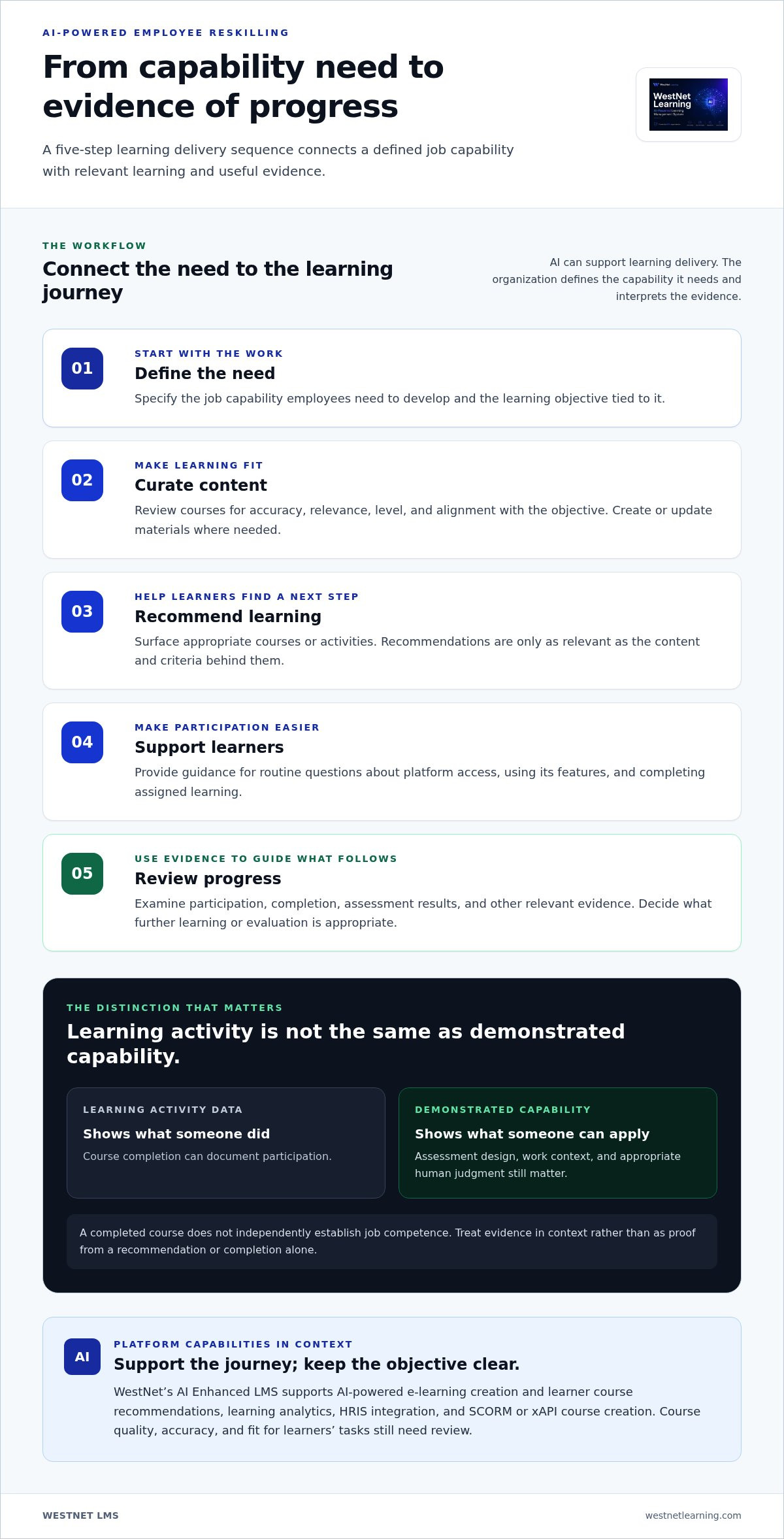
Use this sequence to connect learning delivery to a defined need:
- Define the need. Specify the job capability employees need to develop and the learning objective tied to it.
- Curate content. Review available courses for accuracy, relevance, level, and alignment with the objective. Create or update materials where needed.
- Recommend learning. Surface appropriate courses or activities so learners can find a useful next step. Recommendations are only as relevant as the content and criteria behind them.
- Support learners. Provide guidance for routine questions about accessing the platform, using its features, and completing assigned learning.
- Review evidence. Examine participation, completion, assessment results, and other relevant evidence. Decide what further learning or evaluation is appropriate.
Learning activity data shows what someone did; demonstrated capability shows what they can apply. A completed course can document participation, but it does not independently establish job competence. Assessment design, work context, and appropriate human judgment still matter. Georgetown University's discussion of AI and Workforce Training provides broader context on AI's potential in workforce development and the considerations involved in applying it.
Course creation and learner recommendations
AI-assisted course creation can help learning teams develop e-learning materials for a defined objective, while recommendations can help employees discover relevant content in a larger catalog. Neither removes the need to review course quality, accuracy, and fit for learners’ tasks. WestNet’s AI Enhanced LMS supports AI-powered e-learning creation and learner course recommendations, including SCORM or xAPI course creation. For more on the authoring side, see this AI course creation software guide.
Support, automation, and reporting across the learning journey
Learner and administrator help can make routine platform use easier to manage, while task automation can reduce repetitive administrative work. Reporting gives learning teams a view of recorded activity, such as access, participation, and course completion. Use those signals to spot friction or follow-up needs, not as a substitute for demonstrated skills. WestNet’s AI Enhanced LMS brings learner and administrator help, task automation, and learning analytics into the learning environment. Organizations considering this workflow can explore WestNet's AI learning platform.
How to Compare AI Reskilling Platforms Without Overreading the Claims
Feature labels can sound similar across platforms. Compare what each capability lets your team and learners do, then separate that evidence from claims about business outcomes. An AI powered employee reskilling platform may recommend a course, but the recommendation is an input to a learning decision, not proof that an employee is ready for a new responsibility. Your organization still defines role standards and determines how skills are validated.
Use a capability matrix to make comparisons consistent. For each platform, record what is available, what information it uses, and how your team would evaluate it in a real learning workflow.
| Capability | What to examine | Useful evaluation evidence |
|---|---|---|
| Content creation | How teams create or update learning materials and whether existing content can be used. | A sample course reviewed for accuracy, relevance, and alignment with the learning objective. |
| Recommendations | What informs suggestions and how learners or administrators can act on them. | Example recommendations assessed against the intended role or capability need. |
| Learner support | How learners get help using the platform and finding assigned learning. | A walkthrough of common learner tasks and available support pathways. |
| Analytics | Whether reporting distinguishes access, enrollment, completion, and assessment activity. | Reports that clarify what was recorded and what each measure does not establish. |
| Integrations | How the platform fits relevant HRIS, identity, and learning-content workflows. | A review of required data flows, content compatibility, and implementation dependencies. |
| Administration | How routine learning tasks are managed and what support administrators receive. | A demonstration of the workflows your learning team expects to operate. |
What to examine in AI recommendations and analytics
Ask what learner or course information shapes a recommendation, whether administrators can review it, and what action follows. A useful suggestion should connect to a defined learning objective and suitable material; a ranked list alone does not show that either condition is met. In reports, distinguish enrollment and completion from assessment evidence, and check how the system defines each measure. These enterprise learning analytics considerations can help teams interpret dashboards without treating activity as mastery.
How to compare evidence, governance, and integrations
Evaluate content compatibility and data workflows against your actual environment. For example, if employees access training through an existing identity system, include single sign-on requirements in the evaluation. Review HRIS connections, data migration, and administrator support against implementation needs. Do not assume a listed integration covers every workflow your organization requires.
Apply the same discipline to vendor outcome statistics. Record the metric’s definition, measurement period, learner group, comparison method, and connection to the vendor’s product. A result from a different role or learning context may not predict your own. Document which evidence supports each success measure in your reskilling initiative. The platform can organize delivery and surface recorded activity; your organization sets job standards and validates whether employees can apply the required capabilities.
How to Evaluate an Employee Reskilling Platform in a Pilot
A focused pilot makes platform evaluation a practical test rather than a tour of feature lists. Choose one role, one defined learning need, a representative learner cohort, and a review period that gives participants time to use the materials. Set the scope before setup begins so your team can distinguish platform fit from issues caused by unclear objectives or unsuitable content.
Decide in advance what evidence will inform the next step. A useful baseline may include:
- Whether learners can access the platform and assigned materials.
- Enrollment and completion patterns during the review period.
- Learner feedback on relevance, clarity, and ease of use.
- Results from assessments tied to the learning objective.
- Administrator effort required for setup, support, and reporting.
Interpret the measures carefully. Access and completion show activity, while feedback describes learner experience. Relevant assessments may provide evidence of learning, but none of these measures alone establishes readiness for a role or validates workplace competence. Decide what additional review is needed before the pilot starts.
Design a pilot that tests real learning workflows
Select learners who reflect the intended audience and materials that address the capability need. Have participants test course access, recommendations, and learner support. Ask administrators to complete routine setup and task-management activities. Record where the workflow is clear and where it requires intervention. Define success measures in advance, and do not treat clicks, recommendations, or completions as proof that employees can apply a skill on the job.
Review implementation and adoption readiness
Map the practical work behind launch: user setup, authentication, HRIS data, any required migration, and ownership of administrator tasks. Include existing course materials in the test and check relevant compatibility requirements such as SCORM or xAPI. WestNet’s AI Enhanced LMS offers a free 30-day trial, which teams can use to evaluate real workflows before broader adoption. Use this 30-day AI-powered LMS evaluation guide to plan the trial scope and review.
Close the pilot with a simple scorecard. For each criterion, capture the evidence observed, operational fit, unresolved gaps, and a decision: proceed, adjust, or pause. Note who reviewed the evidence and what must change before expansion. This gives decision-makers a clear basis for comparing expected value with implementation effort.
| Scorecard area | Record |
|---|---|
| Learning workflow | What learners and administrators completed during realistic tasks. |
| Evidence | Baseline and pilot observations, including feedback and relevant assessments. |
| Operational fit | Content, integration, setup, and reporting needs met or outstanding. |
| Decision | Whether to proceed, adjust the scope, or pause, with reasons. |
Keep the pilot narrow, but make the tasks representative. To evaluate the workflow in WestNet’s AI Enhanced LMS, start a free 30-day trial.
How WestNet’s AI Enhanced LMS Supports Employee Reskilling
WestNet’s AI Enhanced LMS brings learning delivery and administration into one platform. For organizations evaluating an AI powered employee reskilling platform, its capabilities support course development, learner discovery, and review of learning activity. The platform helps deliver and manage learning. It is not a standalone workforce skills intelligence system, and it does not independently determine which capabilities the organization needs or confirm employee readiness for a role.
Match WestNet LMS capabilities to reskilling workflows
Map each feature to a practical learning need. AI-powered e-learning creation can help teams develop materials, while AI-generated course recommendations can help learners find relevant courses. WestNet supports SCORM or xAPI course creation, which can help teams assess how learning content fits existing course workflows.
The platform also brings together capabilities that support delivery and administration:
- Analytics and reporting help teams review recorded learning activity.
- Gamification adds engagement features to the learning experience.
- Task automation supports learning administration workflows.
- Learner and administrator help provides assistance with platform use.
- HRIS integration and data migration support connections with employee data workflows.
- Transferable user licenses and support for up to 60 site languages provide options for managing access as users and language settings change.
Together, these capabilities can connect content, recommendations, administration, and reporting. They do not replace the organization’s responsibility to set role expectations, select appropriate learning, and decide what evidence is needed to assess capability.
Evaluate fit through a demo or free trial
Test a representative learning workflow rather than reviewing features in isolation. Choose a learning need, prepare relevant course material, and follow the process from learner access and course discovery through completion and reporting. Check whether administrators can manage the workflow, whether reports provide the information your team needs, and how HRIS integration or data migration fits your implementation plans. WestNet provides administrator support for organizations using the platform.
A demo can help decision-makers understand the platform’s workflows, while the free 30-day trial offers a way to evaluate them directly before wider adoption. Record which requirements the platform supports, where your team needs additional processes, and what evidence will guide an adoption decision. Keep learning activity separate from validated job competence, and define how your organization will assess role-specific capability beyond course participation.
Ready to evaluate the learning workflow in practice? Request a WestNet LMS demo or start a free 30-day trial, then assess how course creation, recommendations, administration, and reporting fit your reskilling priorities.
Turn Your Next Skills Priority Into a Learning Plan
Treat reskilling as an ongoing capability, not a one-time response to change. Choose a workforce priority that matters to your organization, then align decision-makers on what employees need to learn and what evidence will inform future decisions. That clarity keeps technology in service of the work, rather than letting platform features define the strategy.
An AI powered employee reskilling platform can support that effort when its learning workflows fit your people, content, and operational needs. Start with a practical evaluation, gather input from learners and administrators, and use what you learn to shape the next phase of adoption. Connect learning opportunities to real organizational priorities, then refine the approach as those priorities evolve.
Take the next step with WestNet. Request a WestNet LMS demo or start your free 30-day trial to explore how the platform fits your learning goals.
Frequently Asked Questions
What is an AI-powered employee reskilling platform?
An AI powered employee reskilling platform uses AI-supported tools to help organize learning for changing work requirements. For example, a company introducing a new customer support system could use learning technology to prepare relevant materials and direct employees to them. The platform supports the learning program, but leaders still set business priorities and define the capabilities employees need. Recommendations and reports should not be treated as automatic proof of readiness for a different role.
How is an employee reskilling platform different from a skills intelligence platform?
An employee reskilling platform centers on learning delivery, while a skills intelligence platform focuses on workforce skills information and analysis. A learning platform may help an employee access a course, while a skills system may help leaders organize information about capabilities across teams. Organizations may use both, but should assess each against its purpose. A learning management system should not be assumed to independently verify an employee’s skills or role readiness.
Can AI identify which skills employees need to develop?
AI may help suggest learning, but organizations should review those suggestions against business priorities and role expectations. If a team is adopting a new process, leaders can first define the tasks employees will need to perform, then assess whether recommended material addresses them. A recommendation is not a validated skills assessment. If readiness matters, pair learning with a relevant assessment or manager review that considers how the employee applies the capability.
How can organizations measure whether employee reskilling is progressing?
Choose measures that reflect the learning objective, then interpret each as a distinct signal. If employees are learning a new process, course feedback can reveal whether the material is clear, while an assessment can show how well they understand its steps. Neither alone proves consistent performance at work. If the organization needs evidence of workplace proficiency, agree with relevant leaders on how it will be observed and assessed beyond the learning platform.
Does an AI-powered LMS replace a learning and development team?
No. AI can assist with tasks such as preparing course materials or helping learners find content, but people remain responsible for setting objectives and checking that learning is appropriate. A learning team can review whether a course reflects current procedures, while managers can explain how those procedures apply in a specific role. Keep human review in the process, especially when recommendations or learning reports inform employee development decisions.
Can an AI reskilling platform work with existing courses and HR systems?
It can, depending on the platform’s supported content standards and integrations. WestNet’s AI Enhanced LMS supports AI-powered e-course creation in SCORM or xAPI and includes HRIS integration and data migration support. Select a representative course and map the employee data your learning workflow uses. This practical check can help your team identify content or data requirements early and assess how the platform fits existing systems.
What should an employee reskilling platform pilot include?
A useful pilot tests a real learning scenario and records what decision-makers need to know before expansion. A team could test whether employees can access a course, whether administrators can manage the assigned learning, and whether reports answer the review team’s questions. Agree beforehand on what would warrant proceeding, making adjustments, or pausing. Document operational findings and learning evidence so the decision reflects more than platform activity alone.