What if the real test of AI driven employee development isn’t how quickly a platform creates learning, but whether it connects learning to employee needs and provides credible evidence of progress? Training can miss the mark when it isn’t relevant to people’s roles. Participation data alone also can’t show whether employees are building useful skills.
Learning teams face an operational challenge too: development may span separate systems for employee records, course access, enrollment, and reporting. When AI capabilities are described broadly, it can also be hard to tell what a platform does and what evidence would show that it helped. A practical case study framework can bring these questions into focus.
This article shows how to structure a case study around personalized learning, operational fit, and measurable evidence. You’ll see how AI-generated course recommendations, course creation, learning analytics and reporting, automated enrollment, and HRIS integration can fit into an employee development model. Then you’ll learn how to define a baseline, choose relevant indicators, and assess results without making unsupported claims or treating AI as a substitute for human judgment.
Key Takeaways
- Start AI driven employee development with a defined workforce need and role-relevant learning goals, not a feature list.
- Use recommendations to support learning decisions while keeping managers and learners involved in development choices.
- Separate participation measures from indicators of skill development. Course completion alone does not prove job performance.
- Assign clear responsibilities to L&D, administrators, managers, and learners before a pilot begins.
- Match platform capabilities to the evidence you need to collect, then assess what the results can and cannot show.
AI-Driven Employee Development Starts With a Clear Workforce Need
AI-driven employee development uses technology to connect employees with learning activities that relate to their roles and development needs. AI can help organize and recommend learning, but the goal is workforce development, not adopting AI for its own sake. Start by defining the need, then decide which tools could help employees access relevant learning and how the organization will review progress.
This distinction matters when development goals, learning resources, and reporting sit in separate processes. Employees may be offered generic courses that don’t reflect their responsibilities, while learning teams may have limited visibility into course access or what happens after participation. Treat these as questions to investigate, not problems to assume. A case study should ask whether learning can become more relevant and manageable without presenting AI use itself as the result.
If the organization does not have approved evidence from an actual implementation, present the example as illustrative. This keeps the framework useful without implying that a specific implementation or outcome has been verified.
Define the development challenge before introducing AI
Set the scope first. Identify the workforce or role groups involved, the capabilities the organization wants to support, and the learning needs employees have identified. For an illustrative pilot, focus on one role group and a stated development priority. Don’t claim that the group has a skills deficit unless an assessment or other evidence supports that conclusion.
Separate organizational priorities from individual goals. A business may prioritize a capability across a team, while employees have different experience, responsibilities, and next-step interests. Capture both perspectives, then document current friction using information the organization can verify. For example, record how learning is assigned, where course information is stored, and which participation data is available. A structured employee training and development approach can help clarify how learning connects to broader workforce goals.
Set a credible baseline for the case study
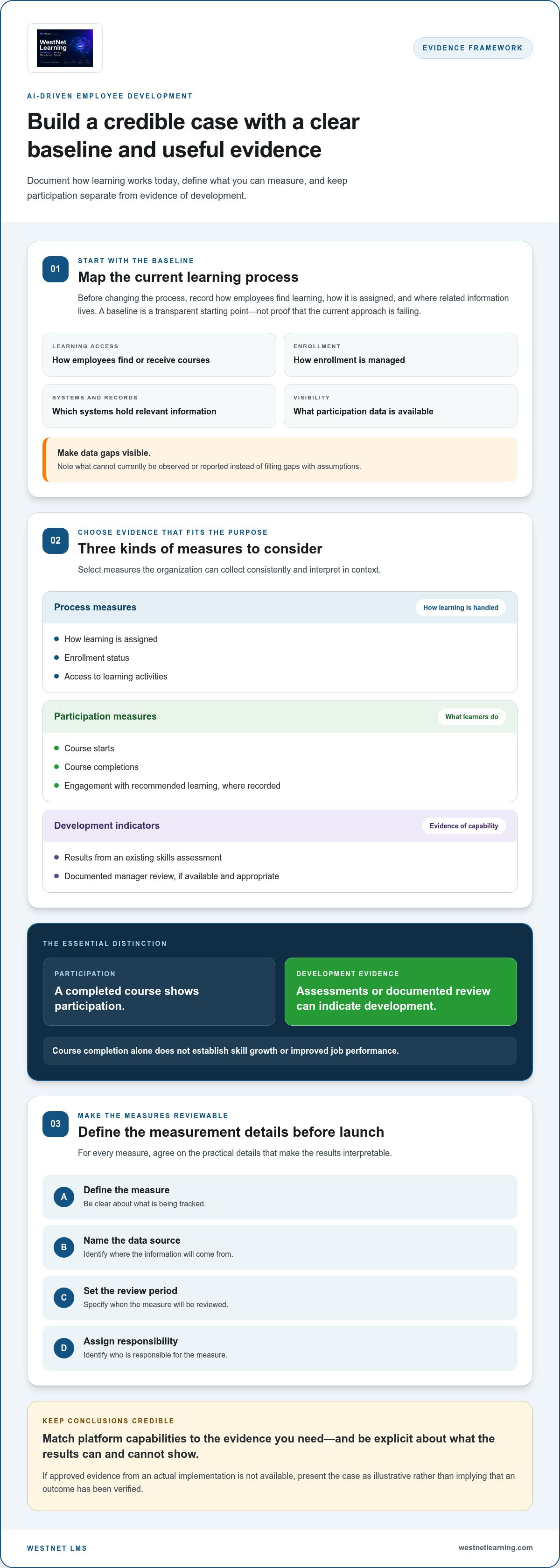
Before changing the process, document how learning currently works: how employees find or receive courses, how enrollment is managed, which systems hold relevant records, and what affects access or reporting. Note data gaps explicitly. The baseline is a transparent starting point, not proof that the current approach is failing.
Choose measures the organization can collect consistently and interpret in context. Depending on the pilot’s purpose and available systems, these might include:
- Process measures: how learning is assigned, enrollment status, and access to learning activities.
- Participation measures: course starts, completions, or engagement with recommended learning, where recorded.
- Development indicators: results from an existing skills assessment or documented manager review, if available and appropriate.
Keep activity separate from evidence of development. A completed course shows participation; by itself, it doesn’t establish skill growth or improved job performance. Before launch, define each measure, its data source, the review period, and the person responsible for it. This gives the case study a credible basis for evaluating what the technology supports and what the evidence can show.
How AI Connects Personalized Learning With Everyday Development
Personalization works best as a connected process, not a one-time course suggestion. It starts with a defined learning need, moves through relevant options and learning activities, and returns to review: does the activity still fit the employee’s goals and role? In an AI driven employee development approach, technology can surface options and support administration, while people remain responsible for development decisions.
Personalize learning without losing human judgment
AI-generated course recommendations can help learners find options related to their needs instead of relying only on a generic course catalogue. Treat each recommendation as a starting point. Employees can assess whether the content fits their goals, and managers can add context about role expectations, upcoming responsibilities, and team priorities. Keep the learning journey open to review and adjustment. Recommendations should not become automatic judgments about career potential.
A recommendation is useful only if it is relevant, accessible, and timely. IBM’s discussion of AI for workforce reskilling and upskilling highlights the role of personalized learning pathways in making development more relevant. Organizations can apply that principle by linking recommendations to an identified need, then asking the learner and manager to review the fit before learning begins.
Connect learning access to the employee lifecycle
After a learning activity is selected, the next challenge is making it easy to access and administer. Automated enrollment can support consistent assignment when a learning requirement applies to a defined group or role. HRIS integration can connect learning administration with employee data workflows, helping coordinate workforce records and learning operations. These capabilities can support access and administration, but they don’t guarantee course completion or proficiency.
AI-powered help can support learners and administrators as they use the learning environment. Describe it as a support capability, not a promise that every question will be resolved or that learning outcomes will follow automatically. In a pilot, note where employees encounter friction and whether available help supports them through the process.
Motivation deserves attention too. Gamification elements can add structure and recognition to learning activities, but they should reinforce meaningful participation rather than distract from the development goal. Consider how employee engagement gamification tools fit the learning journey, then evaluate engagement separately from skill development.
For teams mapping these functions to an operational approach, the WestNet AI LMS includes learner recommendations, automated enrollment, HRIS integration, and AI-powered help for learners and administrators. These capabilities can support a more connected learning process, while managers and learners remain central to deciding what development means in practice.
Evaluate AI-Driven Employee Development by Evidence, Not Feature Claims
A platform feature describes what a system can do. A case study should show what the organization observed, how it measured that evidence, and whether the result addressed a defined workforce need. Evaluate AI driven employee development by connecting each capability to a practical question and a measure the organization can interpret. Keep conclusions within the limits of the available data.
Use consistent definitions when comparing the existing process with a proposed workflow. If the current process tracks enrollment by assigned course, use that same definition when reviewing the new workflow. Record the data source, time period, and workforce group for every measure. This makes comparisons more useful while leaving room to account for changes in staffing, course content, or other conditions that may affect results.
Choose measures that match the development objective
Select indicators based on what the learning initiative is intended to support. Enrollment, participation, and completion describe activity. Assessment results may indicate development when the assessment is relevant and consistently applied. Job-related measures can add context, but only when the organization can define and validate them. A course completion record alone doesn’t prove improved job performance, and a relationship between learning and a workplace change doesn’t establish that the platform caused it.
Assess capability, evidence, and operational fit
Compare platform capabilities with documented requirements, then assess whether the resulting evidence is usable. Reports support decisions only when administrators can understand the measures, identify the relevant population, and act on the information available. Use the table as a starting point, adapting each row to the pilot’s objectives and actual data sources.
| Need | Capability | Evidence to inspect | Outcome to assess | Open evaluation question |
|---|---|---|---|---|
| Help learners find relevant courses | AI-generated recommendations | Recommended options and recorded learner engagement | Whether employees access learning relevant to the stated need | Can learners and managers judge the recommendations’ relevance? |
| Coordinate learning assignment | Automated enrollment | Assignment records and enrollment status | Whether the intended group receives access through the planned workflow | Are assignment rules clear and operating as intended? |
| Review learning activity | Analytics and reporting | Report definitions, data coverage, and available results | Whether administrators can monitor the measures tied to the objective | Can decision-makers interpret and use these reports? |
| Connect learning operations | HRIS integration | Relevant employee data workflows and integration records | Whether the setup supports the required administrative process | Does the data flow match documented requirements? |
Use the same measure definitions and review criteria for the existing process and the proposed workflow. For more guidance on connecting LMS data to employee performance measures, see this practical approach to employee performance tracking in an LMS. Report what changed, what remained unclear, and what the data cannot establish.
Plan an AI Employee Development Pilot With Clear Guardrails
A focused pilot makes AI driven employee development easier to evaluate. Keep the scope manageable: define a specific learning need, configure a relevant learning journey, and decide in advance what evidence will inform the next step. The purpose is to test whether the workflow supports employees and learning operations, not to promise organization-wide transformation.
Build the pilot in sequence:
- Define the need. Select one role group or learning objective. Document the intended development activity and why it matters to the organization.
- Configure the journey. Set up relevant learning access and any recommendations or enrollment processes in scope. Record learner access requirements and how the activity fits existing workflows.
- Review the evidence. Compare observations with the baseline using consistent measure definitions, then decide whether to refine, extend, or pause the pilot.
Launch with a focused learning use case
Choose a use case the organization can monitor with its available people, systems, and data. Before launch, document the starting conditions, learner group, access needs, and intended activity. Set expectations about what the pilot can assess and what it cannot establish. A narrow scope supports clearer interpretation and helps the team identify workflow issues before considering wider adoption.
Assign ownership before learners begin. Clear responsibilities help prevent gaps in setup, communication, and review:
- L&D defines the learning objective, journey, and measures for review.
- Administrators configure access, enrollment, reporting, and relevant system workflows.
- Managers provide role context and discuss whether the learning remains relevant to development priorities.
- Learners engage with the activities and share feedback about relevance and access.
Review progress and adjust the workflow
Set review points before launch, including who will take part and which information they’ll use. Compare pilot observations with the baseline using the same definitions. Pair platform reporting with learner and manager feedback to capture both recorded activity and practical experience. Follow organizational policies for data access, handling, and sharing, and make clear who can view the information.
Record limitations, unexpected effects, and adjustments alongside positive observations. For example, if learners can access courses but report that recommendations don’t match their responsibilities, document the mismatch and refine the workflow before drawing conclusions. Don’t interpret increased participation as proof of skill growth or attribute workplace changes to the platform without supporting evidence.
Use the review to make a deliberate decision: continue as configured, adjust the learning journey, or gather better evidence before expanding. To assess how the WestNet LMS could support a pilot’s learning and administration workflow, include a WestNet LMS demo in the evaluation.
Where the WestNet AI Enhanced LMS Fits in the Development Case
The WestNet AI Enhanced LMS can support several steps in an employee development workflow, from creating learning content and surfacing course recommendations to administering enrollment and reviewing activity. Organizations can evaluate these capabilities against their requirements. The capabilities are not, by themselves, evidence of improved skills, performance, or business results. In an illustrative case study, describe what the platform can support, then assess implementation using the organization’s own measures.
Match confirmed capabilities to the development workflow
Connect each capability to a specific need. AI-powered course creation can support e-learning content workflows. AI-generated course recommendations can help learners discover relevant options, with managers and learners retaining a role in judging whether those options fit development priorities. Automated enrollment can support course assignment, while HRIS integration can connect learning administration with employee data workflows.
Learning analytics and reporting can provide information for reviewing measures such as enrollment, participation, and course completion, depending on the organization’s evaluation plan. Interpret reports in context. Activity data can show how employees use learning, but it doesn’t establish that they developed a skill or improved job performance. Gamification can add participation features to the learning experience, but it is not proof of proficiency.
Other capabilities may matter to specific organizations. Support for up to 60 site languages may be relevant when learners need to access the platform in different languages. Assess this capability against actual learner needs and organizational requirements rather than treating it as a universal benefit.
Make the next evaluation step practical
Bring the development objective, intended learner group, existing systems, and chosen measures into the platform evaluation. This helps decision-makers assess whether recommendations, content creation, reporting, enrollment automation, and integrations align with the workflow they need to support. Broader employee training and development goals can also help frame how a learning platform fits into an organization’s overall approach.
Keep the case study grounded in evidence. If approved customer information and verified results are not available, use an illustrative scenario and make no claims about outcomes. Record what was configured, what data was observed, and what remains uncertain. This makes the evaluation useful without overstating what AI or a platform feature delivered.
WestNet offers a free 30-day trial and demos to help organizations evaluate the platform against their development goals, learner groups, systems, and evidence plan.
Turn Your Development Strategy Into a Measurable Next Step
Make development priorities actionable by choosing a workforce need that matters now, agreeing on what evidence would inform a decision, and building a process your team can refine. This keeps AI driven employee development focused on employees and organizational goals, while leaving room for human judgment when priorities or roles change.
You don’t need to decide what success looks like before you begin. Start with a clear question, establish how you’ll evaluate the learning experience, and use what you observe to shape the next stage. A practical evaluation can help your organization move forward without relying on broad claims about AI.
Request a WestNet LMS demo to explore how the platform could fit your development priorities. Start with a focused question, then build from evidence.
Frequently Asked Questions
What is AI-driven employee development?
AI-driven employee development uses AI-enabled tools as part of a broader process to support workplace learning and growth. For example, a learner might receive course suggestions related to a capability they want to build, while a manager helps connect that learning to current responsibilities. The technology supports discovery and administration; it doesn’t define an employee’s potential or replace the organization’s responsibility to set meaningful development goals.
How can AI personalize employee development?
AI can help personalize development by using available learning information to suggest relevant courses or activities. A learner exploring a new responsibility, for instance, may find recommendations that offer a starting point for discussion with a manager. Personalization still depends on content quality and context. Employees and managers should review whether suggestions reflect actual goals, experience, and role expectations, then adjust learning choices when needed.
Can AI measure employee development accurately?
AI can help organize and report learning data, but no single measure captures development accurately in every context. A course record can show participation; a role-related assessment or structured review may provide different evidence. Decide what each measure represents before interpreting it, and consider data quality and relevant workplace factors. Avoid using automated scores alone to make consequential judgments about an employee’s ability or future.
What should an AI employee development case study include?
A useful case study documents the learning objective, the group involved, the process before and after implementation, and the evidence used to assess the change. Include how measures were defined, where data came from, and who reviewed it. For example, distinguish improved access to assigned resources from evidence of skill growth. If results or customer details aren’t approved and verified, label the scenario illustrative rather than presenting it as a real case.
Does AI replace managers in employee development?
No. AI can help surface learning options or organize information, but managers provide context about responsibilities, team needs, and employee aspirations. They can discuss whether a suggested activity is relevant and help employees apply learning in their work. Learners also need a voice in setting goals. Treat AI as decision support, not an authority on career potential, promotion readiness, or individual performance.
How can an organization evaluate an AI learning platform?
Evaluate a platform by testing its capabilities against a defined use case. For example, map a need for easier course discovery to recommendations, then assess whether learners can find relevant options and administrators can review appropriate reports. Consider integration and enrollment workflows alongside reporting, usability, and access requirements. A demo or trial can help stakeholders explore the workflow before deciding whether it fits their requirements.